


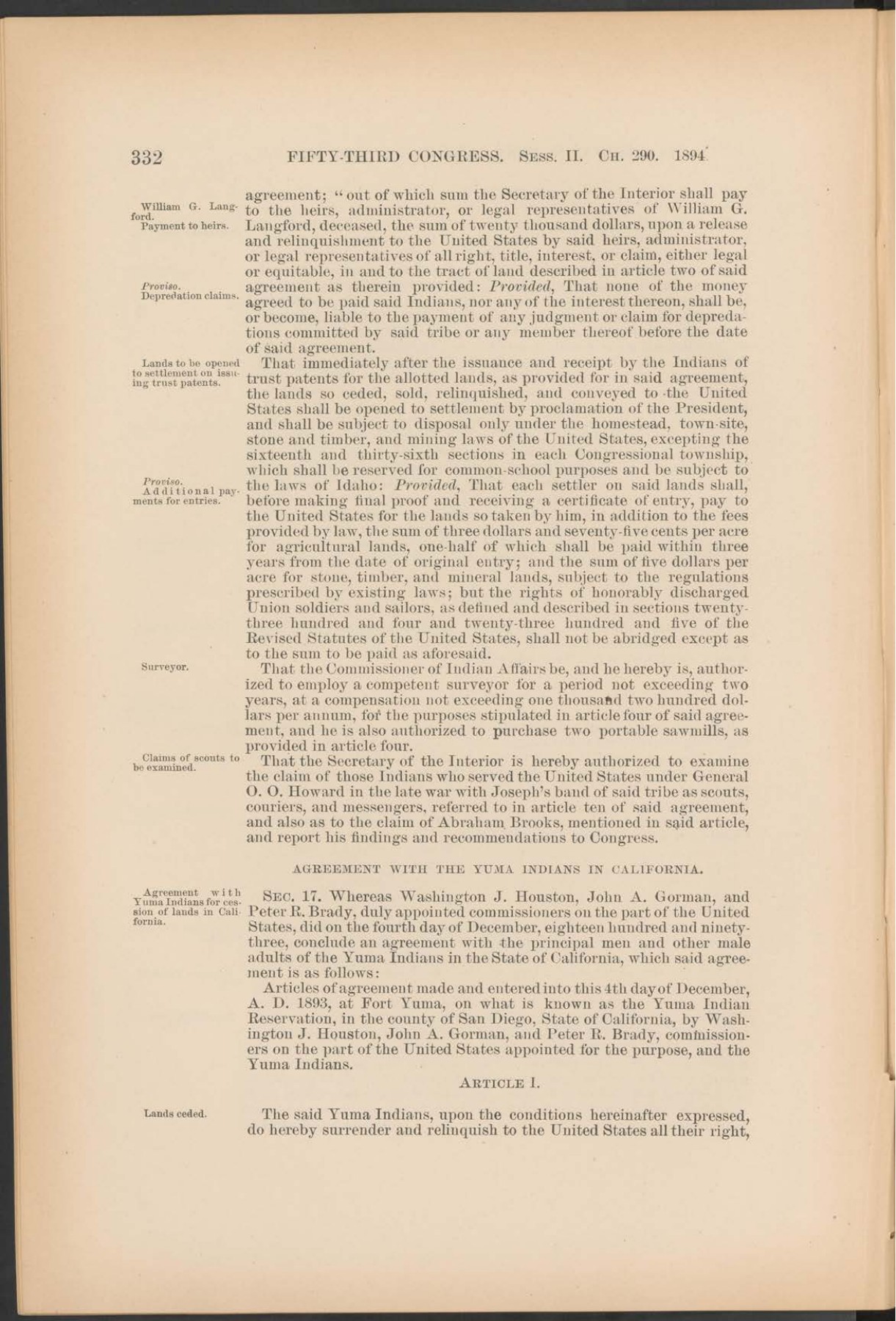
Congress's August 15, 1894 act did not merely attach an approval date to the Yuma agreement. Section 17 reproduced the agreement and set out directions for carrying the arrangement into effect. It addressed the promised allotments, disposal of remaining lands, management of proceeds, irrigation, and the opening of non-irrigable acreage. The later controversy over reservation lands depended in part on how those directions related to the agreement's surrender language. [1]
The statute belongs to a longer sequence. Commissioners and Yuma signatories reached the agreement on December 4, 1893. Interior transmitted it to the Senate with reports and proposed legislation in March 1894. Congress then ratified and implemented the arrangement in August. Each step generated a different kind of record: negotiated terms, administrative recommendations, and enacted law. [1] [2] [3]
Keeping those layers separate is especially important here. A statement in a commission report does not become a statutory command simply because the report accompanied the agreement. Conversely, congressional directions following the reproduced articles cannot be ignored because a shorter transcription ends with the agreement's signatures. The full section is the relevant legislative record.
More than the first article
Article I of the agreement contained broad surrender and relinquishment language tied to conditions stated later in the document. The following articles described five-acre individual allotments, the sale of surplus irrigable lands, a fund for the Tribe, trust protections, non-irrigable land, and school property. Article VIII required congressional approval before the agreement took effect. [2]
Section 17 supplied that approval while continuing into implementation. The complete section spans printed pages 332 through 336 of volume 28 of the Statutes at Large. Its location within a larger appropriations act can make it easy to miss. The surrounding pages address other matters, so the section number and page span are necessary to identify the provision precisely. [1]
Reading the entire section reveals why later legal opinions could not resolve the dispute simply by pointing to the date of ratification. The question was also what the approved arrangement required, whether its directions were conditions of the cession, and whether the government's subsequent actions satisfied them. Ratification was a major event, but the meaning of performance remained contested.
Allotments before the remaining land was sold
The agreement's allotment scheme gave individual members a defined place in the proposed agricultural arrangement. It contemplated selections, federal administration, approval, and trust patents. The sale provisions concerned the residue after the protected allotments and exceptions were accounted for. That order of operations mattered because the land available for sale depended on what had first been retained or allotted. [1] [2]
For irrigable lands destined for sale, the statutory provisions continued the use of surveys, subdivisions, appraisal, notice, and minimum values. Public sale and later reoffering were part of the process. Private sale remained tied to stated circumstances and the appraised floor. The scheme was therefore an administered transaction, not a bare statement that all unallotted land instantly became available on any terms.
The economic connection was equally important. Revenue from one part of the reservation was intended to support benefits associated with the remaining arrangement. An account that treats the sales as unrelated to the allotments misses the statute's financial design. An account that assumes successful sales merely from their authorization confuses what Congress directed with what later records would have to show actually happened.
The promised proceeds had a defined destination
The statute provided that land-sale money, after specified deductions and reimbursements, would be credited to the Yuma Indians in the Treasury and draw five percent annual interest. The principal and interest were subject to congressional appropriation or presidential application for stated purposes. Those included water rents, levees, irrigation works, tools, farming supplies, and education. [1]
This was not a promise that every dollar received at sale would immediately be handed to individuals. Costs and reimbursements affected the amount reaching the fund, and federal institutions controlled its application. The preceding administrative correspondence helps explain the stakes: Secretary Hoke Smith had questioned charging construction costs to the Indians before adequate investigation of flood-protection works. The finances of the plan were under discussion before enactment. [3]
The statute also barred use of these proceeds and their interest to pay judgments for depredation claims arising before the agreement. That provision narrowed the purposes for which the fund could be diverted. It belongs in the account because it shows Congress addressing not only anticipated agricultural benefits but also competing potential demands on the money. [1]
Presidential action for non-irrigable land
The non-irrigable acreage followed a different route. The statute stated that lands ceded under the agreement that were not susceptible of irrigation would become part of the public domain and be opened to settlement and sale by presidential proclamation, under the general land laws. The proclamation language became significant in later examination of whether the contemplated disposition occurred. [1] [6]
The text should not be flattened into a modern headline that either all reservation land remained untouched or all land automatically passed out of the reservation without further consideration. Those are conclusions about the operation of the full arrangement. The statute provides the language that later officials interpreted, including its reference to lands ceded, its agricultural classification, and its direction for presidential action.
In 1978, Solicitor Leo Krulitz treated the absence of the contemplated proclamation as part of the record supporting his conclusion that the conditional cession had not been completed. Earlier Interior analysis had reached a different conclusion about extinguishment of title. The historical significance lies in that interpretive disagreement over the same legislative sequence, not in pretending that the statute's effect was never disputed. [5] [6]
Irrigation came with deadlines and qualifications
Congress also addressed the proposed canal. The Colorado River Irrigating Company, which had received a canal right of way through the reservation under the February 15, 1893 act, was required to begin construction within three years of the 1894 act. Failure to do so would forfeit the rights granted by the earlier statute. The provision attached a time condition to a specific infrastructure opportunity. [1]
The law gave Interior authority to fix water rents for domestic, agricultural, and irrigation purposes. It further provided qualifying adult Yuma men with rent-free water for one acre of their allotments, if used to grow crops, for ten years beginning when the company started delivery on the reservation. The starting event was water delivery, not the signature date of the agreement or the enactment date of the statute.
These details show why irrigation cannot be relegated to background scenery. It connected the agricultural usefulness of an allotment to a proposed delivery system, a construction deadline, payment rules, and a limited period of free water. The agreement's promised transformation depended on infrastructure and administration as well as the legal description of land.
The provision consequently contains more than one clock. The canal-construction deadline ran from passage of the act. The period of free water ran from the company’s commencement of delivery. The allotment selection procedure, reproduced in the agreement, depended on notice from the designated agent. A single elapsed period after August 1894 would not answer whether each of those different triggers had occurred. [1]
The beneficiaries and extent of the water concession were also specified. The law did not promise ten years of free irrigation for every acre of every allotment. It addressed one acre of a qualifying adult male allottee's land, required its use for crops, and measured the benefit from actual delivery. Those limitations are part of the enacted bargain and help explain why later performance had to be evaluated against particular obligations.
This specificity makes the statute a stronger historical source than a general statement that Congress promised irrigation. The legislature identified an infrastructure project, a deadline, a consequence for nonperformance, administrative authority over rents, and a limited individual benefit. The later opinions disagreed about the legal result of the overall arrangement, but the details they interpreted remain available in the statutory text.
Later reclamation did not end the interpretive question
Congress adopted a different reclamation provision in 1904, addressing irrigable land on the Yuma and Colorado River reservations through the 1902 reclamation framework. It included five-acre allotments and a different financial arrangement for disposal of other irrigable land. The overlap in subject matter made the later statute important to arguments over whether the earlier promises had eventually been performed. [4]
Krulitz's 1978 opinion rejected the premise that activity under the later framework completed the conditional cession contemplated in 1893 and 1894. Margold's 1936 analysis had reached the contrary land-title result. To understand the disagreement, readers need both statutes, the agreement, and the competing opinions. The existence of later irrigation activity is not, by itself, a substitute for identifying which legal arrangement authorized it and what terms governed it. [5] [6]
Section 17 joined several governmental tasks in one provision: approval of the agreement, directions for allotment and sale, treatment of proceeds, and measures concerning irrigation. Its design linked the proposed transfer of land to the benefits expected from developing that land. The later dispute turned on those connections. Whether the government had fulfilled the arrangement could not be answered solely by pointing to surrender language while leaving the accompanying promises and implementing provisions out of account.
Sources
1. Act of August 15, 1894, ch. 290, § 17, 28 Stat. 286, 332–336. Act of August 15, 1894, section 17; 28 Stat. 332–336. Download PDF · Source publication · Source PDF excerpt (5 pages).
2. Agreement of December 4, 1893; S. Exec. Doc. No. 68, 53d Cong., 2d Sess., pp. 19–22 (1894). Articles I–VIII. Read source PDF · Source publication
3. S. Exec. Doc. No. 68, 53d Cong., 2d Sess. (March 21, 1894). Secretary's letter and accompanying reports; pages 1–4. Read source PDF · Source publication
4. Act of April 21, 1904, ch. 1402, § 25, 33 Stat. 189, 224–225. Section 25; 33 Stat. 224–225. Read source PDF · Source publication
5. M-28198 (January 8, 1936), Opinions of the Solicitor Relating to Indian Affairs, vol. 1, pp. 596–601. M-28198; pages 596–601. Read source PDF · Source publication
6. M-36908 (December 20, 1978), published at 86 I.D. 3–22 (1979). M-36908; 86 I.D. 3–22. Read source PDF · Source publication