

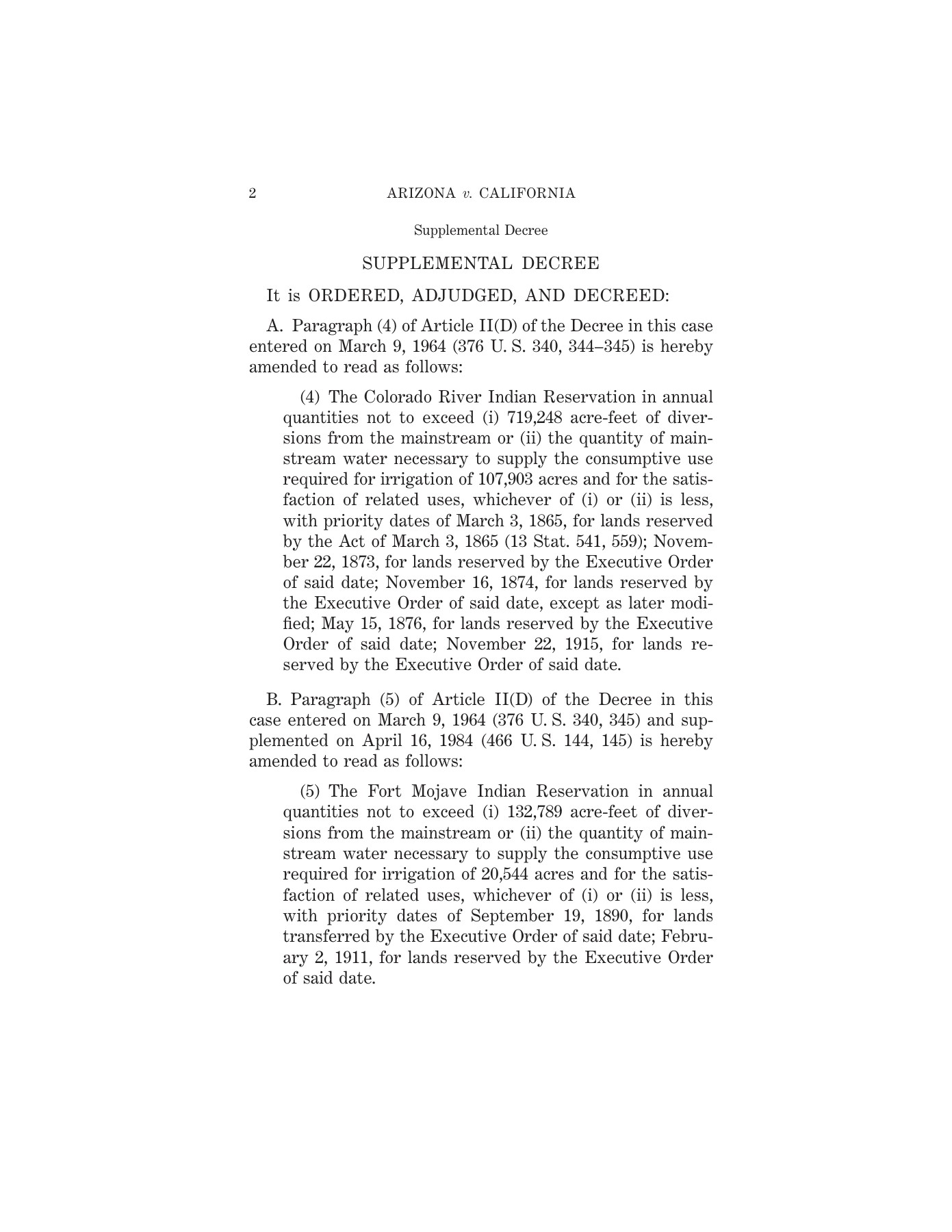
The Supreme Court entered a supplemental decree in Arizona v. California on October 10, 2000. Its two pages amended water provisions for the Colorado River Indian Reservation and the Fort Mojave Indian Reservation. It did not supply the final settlement of the Quechan Tribe's additional Fort Yuma water claims. Those claims had been returned for further proceedings in the Court's June opinion and reached a later resolution. [1] [2] [3] [4]
The June opinion and October decree share a case name, docket, and calendar year, but they performed different work. In June the Court rejected barriers to the Fort Yuma claims while also approving proposed settlements for other reservations. In October it entered amended water provisions for Colorado River and Fort Mojave. Fort Yuma's outstanding claims remained on a separate procedural path toward further proceedings and eventual settlement. [1] [2]
That division allowed the litigation to advance without resolving every reservation's claims at once. The October decree gave operative effect to two settlements already ready for implementation. The Quechan claims, by contrast, had survived threshold objections and still required further proceedings. The quantities and priorities stated in the October amendments belonged to the reservations named in those provisions, not to an additional Fort Yuma award.
The June opinion produced more than one result
In June 2000, the Court addressed the Fort Yuma preclusion dispute and also considered proposed settlements for Fort Mojave and Colorado River. It rejected the asserted barriers to the Fort Yuma claims and remanded those outstanding issues. Separately, it accepted recommendations approving the other reservations' settlements and invited objections to a proposed supplemental decree. [2]
That combination meant the case advanced differently for different parties and claims. Some agreements were ready for implementation in the decree; another set of claims required further proceedings. The shared litigation did not require every reservation's dispute to reach the same stage on the same day.
The October document records the next step for the proposed decree. It states that no objections were filed and approves and enters the supplemental provisions. The absence of objections is relevant to the procedure described in this document. It should not be expanded into a claim that every historical boundary dispute in the entire case had disappeared.
The Colorado River provision
The decree amended Article II(D)(4) of the 1964 decree for the Colorado River Indian Reservation. It specified an annual ceiling expressed as the lesser of two measures: 719,248 acre-feet of mainstream diversions, or the quantity needed for the consumptive use associated with irrigation of 107,903 acres and related uses. The document also listed priority dates tied to specified reservation-creating or modifying acts. [1]
Those figures are stated here as the terms of the 2000 amendment. They are not Quechan allotments, and they are not observations of how much water was actually diverted in a later year. A decree's authorized quantity and an operational use report are different kinds of evidence.
The two-part formulation also matters. Quoting only the larger-looking diversion figure would omit the alternative limit and the instruction to use whichever is less. The complete sentence defines the entitlement through both the quantity and its qualifying terms. That is why even a two-page decree benefits from an explanation that follows the operative language carefully.
The Fort Mojave provision
The decree separately amended Article II(D)(5) for the Fort Mojave Indian Reservation. It used a similar structure: the lesser of 132,789 acre-feet of mainstream diversions or the quantity needed for the consumptive use associated with irrigation of 20,544 acres and related uses. It identified priority dates associated with the executive orders specified in that paragraph. [1]
This amendment addressed the Fort Mojave settlement track described in the June opinion. Its presence beside the Colorado River amendment does not make either provision a general rule applying to every reservation in the case. The numbered paragraphs identify particular reservations and particular quantities.
Fort Mojave's amended provision thus addressed a distinct reservation and a distinct settlement. Its quantities could be incorporated into the same interstate decree as other reserved rights without becoming interchangeable with them. The case's common framework accommodated separate allocations, priority dates, and histories. That structure explains why resolution for one reservation did not automatically determine the amount available to another. [1]
A supplemental decree changes an existing instrument
The October order did not begin the interstate litigation anew. It amended specified provisions of the decree entered in 1964 and, for Fort Mojave, referenced the later supplemental decree as well. Its wording assumes an existing judicial framework whose terms are being updated in identified places. [1]
That structure explains why the document's first page lists earlier opinions and decrees. The sequence is not decorative citation history. It locates the amendments within an ongoing adjudication and tells readers which earlier text is being changed. Without that context, the two pages can appear to be a complete water-allocation code when they are actually a targeted modification.
The 2006 consolidated decree later brought substantive provisions from the earlier decrees together while implementing the Fort Yuma settlements. That consolidation makes the older amendments easier to locate in a single reference, but it does not erase the distinct dates and circumstances under which they were first entered. [4]
The sequence also distinguishes the date an opinion was decided from the date a decree was entered. The first page recites both kinds of event across the case's history. A timeline using only the word decided for every entry can hide that distinction. Here, June supplied the opinion and proposed terms; October supplied entry of the supplemental decree after the opportunity for objections. The document itself records that transition. [1] [2]
Fort Yuma remained on remand
The June opinion's Fort Yuma disposition rejected two preclusion defenses and returned the outstanding claims to the Special Master. It did not finally quantify those claims. The October decree's silence on a new Fort Yuma allocation is consistent with that procedural posture, rather than an accidental omission to be filled by borrowing another reservation's numbers. [2]
The 1999 filings help explain what had been decided at the threshold. The state parties argued for a bar based on the earlier water litigation, while the Tribe and the United States challenged a bar based on an earlier claims settlement. The Court's decision allowed the additional claims to continue past those objections. [5] [6]
The 2005 report then describes the further Fort Yuma proceedings and the eventual negotiations. That later history would make little sense if the October 2000 order had already supplied the final Quechan settlement. Reading the documents in sequence makes their different functions clear without relying on assumptions drawn from their common case caption. [3]
Boundary agreements and water agreements are not always identical
The Special Master's later report explains that the settlements for the other reservations had their own terms concerning boundaries and water. In particular, its account of the Colorado River settlement distinguishes resolution of water disputes from leaving a boundary dispute unresolved among the parties. That is another reason not to equate every water decree with an unrestricted determination of all land questions. [3]
The operative October text focuses on amended water quantities and priorities. It does not purport to narrate every term of every underlying agreement in its two pages. A reader interested in the complete negotiated arrangements needs the associated settlement materials and the Court's account, not merely the final numerical paragraphs.
For Fort Yuma, later settlement documents likewise contain carefully framed agreements and reservations of position. The common lesson from the record is concrete: identify which dispute a particular provision resolves and which matters the parties expressly leave outside it. The case name alone is not enough to answer that question.
From proposed terms to an entered decree
The decree appears at 531 U.S. 1–2. The first page identifies the earlier opinions and decrees and records that no objections had been filed to the proposed supplemental terms. The operative text then changes the specified paragraphs for Colorado River and Fort Mojave. The short instrument implements an approved settlement within an established decree, relying on the existing litigation and its prior rulings for the broader framework. [1]
Its brevity reflects the stage the two settlements had reached. The Court did not repeat the full history of the land claims or every argument made during the proceedings. Instead, it entered the amendments following the opportunity for objections. The resulting paragraphs supplied the water quantities and priorities to be incorporated into the decree for the two named reservations. [1] [2]
The June opinion is reported at 530 U.S. 392; the supplemental decree was entered October 10, 2000 at 531 U.S. 1–2. The separate dates and citations mark the transition from the Court's disposition and proposed terms to the entry of the amended provisions. Fort Yuma's later final resolution followed a different timetable. [1] [2] [4]
The place of this decree in the Quechan account
The October decree is a neighboring chapter in the same litigation, not the final chapter of the Fort Yuma claim. It demonstrates that a large original-jurisdiction case can resolve some disputes through settlement while others remain active. It also explains why the historical record contains several decisions with the same caption and different legal effects.
The Quechan sequence continues from the June remand to the 2005 settlement recommendations and the March 2006 approval and consolidated decree. Those are the documents that record the later negotiated resolution. The October 2000 decree remains available so readers can see exactly what it did and avoid assigning it a result that belongs to another date and another instrument. [3] [4]
Sources
1. Arizona v. California, 531 U.S. 1–2 (2000), supplemental decree entered October 10, 2000. Arizona v. California, 531 U.S. 1–2; decree entered October 10, 2000. Download PDF · Source publication · Source PDF excerpt (2 pages).
2. Arizona v. California, 530 U.S. 392 (2000). 530 U.S. 392; disposition and proposed supplemental decree, pages 418–422. Read source PDF · Source publication
3. Arizona v. California, No. 8, Original, Special Master’s Approval of Final Settlements and Recommendations (June 14, 2005). Account of the separate settlements and subsequent Fort Yuma proceedings. Read source PDF · Source publication
4. Arizona v. California, 547 U.S. 150 (2006), decree entered March 27, 2006. Consolidation of prior decrees and implementation of the Fort Yuma settlement. Read source PDF · Source publication
5. Arizona v. California, No. 8, Original, Exception by State Parties to Report of Special Master and Supporting Brief (December 20, 1999). State parties' exception concerning the Fort Yuma claims. Read source PDF · Source publication
6. Arizona v. California, No. 8, Original, Exception of the Quechan Indian Tribe to the Report and Recommendation of the Special Master and Supporting Memorandum (December 20, 1999). Tribe's exception concerning the Fort Yuma claims. Read source PDF · Source publication