

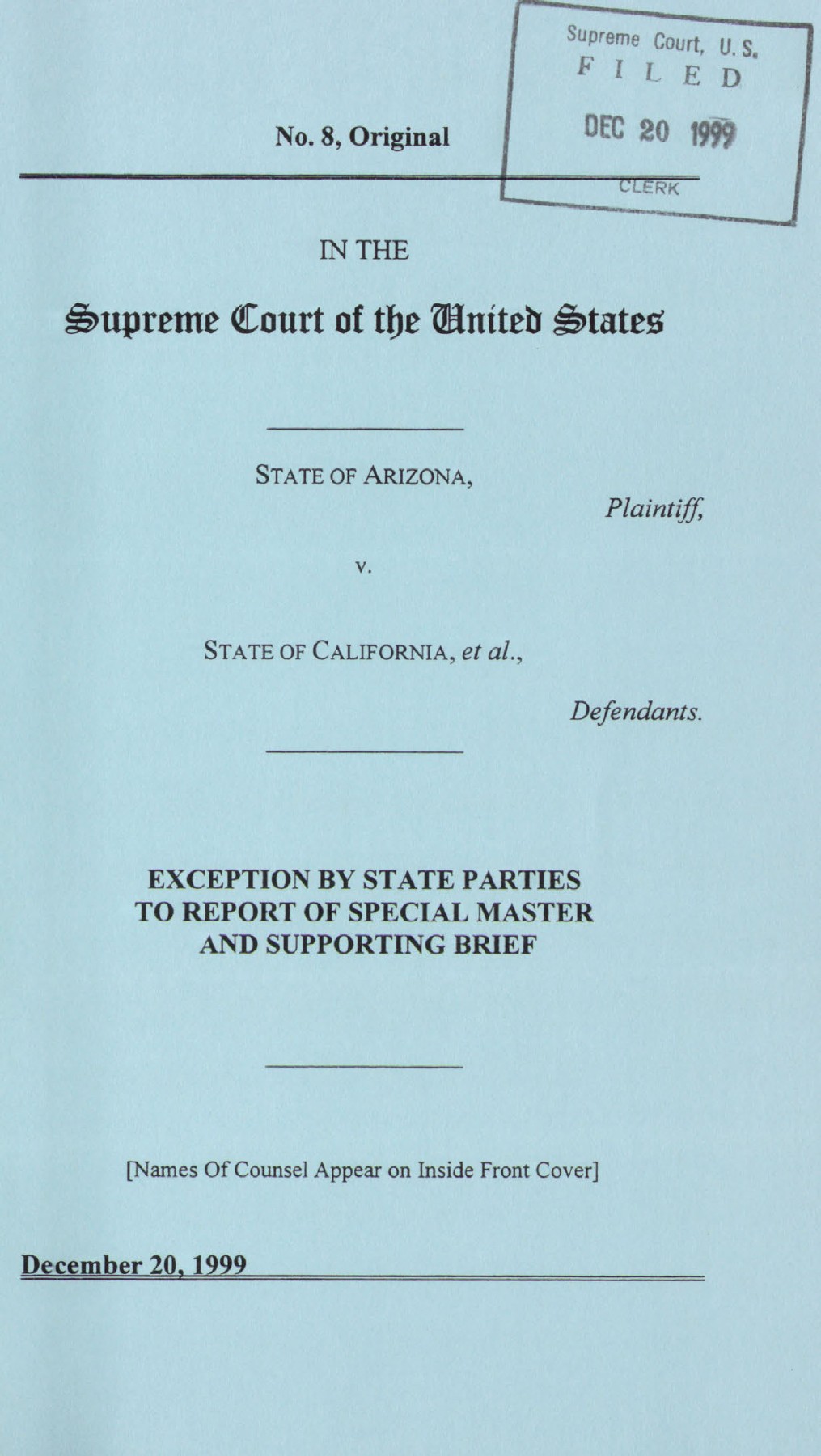
The December 1999 state-party filing asked the Supreme Court to stop additional Fort Yuma water claims on a ground the Special Master had rejected. The parties were Arizona, California, Coachella Valley Water District, and the Metropolitan Water District of Southern California. They argued that the finality principles governing the earlier Arizona v. California proceedings should prevent the Tribe and the United States from pursuing the additional boundary-land claims. [1]
The filing is important because it identifies a defense distinct from the earlier Claims Court settlement. The Special Master had accepted the settlement-based defense but rejected the argument based on the original water litigation. The state parties sought review of the latter ruling, while the Tribe and the United States challenged the former. The Court therefore faced competing exceptions directed at different parts of one report. [2] [3] [4]
The state parties' filing presented the argument against allowing the additional claims to proceed. It framed finality as a barrier even after Interior's recognition of the disputed lands. The Court ultimately rejected that defense, but the brief identifies a central obstacle the Tribe faced before the water claims could reach further proceedings. The controversy concerned not only the underlying land history but also when that history could be litigated.
Why the water allocation mattered to the states
Additional reserved water for the Fort Yuma reservation had consequences within the wider Colorado River allocation. The earlier litigation had been intended to provide certainty about the quantities and priorities different users could expect. The Supreme Court's opinions describe the practical importance of that certainty and the potential effect of additional senior rights on other users. [2]
The state parties framed their defense around that concern for finality. Their argument was that claims which could have been presented in the original proceeding should not be revived later merely because the federal government changed its view of the land underlying them. That was a legal position about the effect of prior litigation, rather than a denial that the Tribe and the United States were now asserting additional rights.
Understanding the argument does not require accepting it. It requires identifying what the parties sought to protect and how they proposed to do so. The brief aimed to end the claims through preclusion, thereby avoiding a later determination of the underlying boundary and water questions. The Court's response turned in significant part on the history of when that defense had been asserted. [2]
Boundary lands and omitted lands were different labels
The earlier water litigation had addressed claims involving so-called omitted lands: acreage within undisputed reservation boundaries for which additional water had not been sought in the original allocation. In 1983, the Court applied finality principles to prevent recalculation for those omitted lands. The state parties argued that the same reasoning should apply to the Fort Yuma boundary-land claim. [1] [2]
Boundary lands involved a different setting. The asserted reservation status of the land itself had been disputed, and later decrees preserved a route for appropriate adjustments if boundaries were finally determined. The parties disagreed about how that history interacted with the earlier failure to claim the additional water. Similar vocabulary about land and acreage did not make the procedural histories identical.
This distinction is one of the most useful explanations an article can provide. The case was not about a generic second request for more water detached from earlier proceedings. It concerned categories the litigation had treated differently and a continuing dispute over what remained open. The state brief urged the Court to extend the omitted-land finality reasoning to the boundary-land claims.
Interior's reversal was part of the argument
The state parties also addressed the significance of the 1978 Interior opinion recognizing the Tribe's claimed interest in the disputed lands. They challenged the Master's treatment of that development in relation to the earlier proceedings. The underlying issue was whether the changed federal interpretation supplied a sufficient reason to consider claims not pursued in the first round. [1]
Krulitz's opinion had concluded that the old cession was conditional and uncompleted. That was a major change from the 1936 and 1977 departmental positions. But the Supreme Court's water litigation had its own procedural history, and the effect of that administrative change within the judicial case was not self-executing. [5]
The distinction is important for a balanced historical account. The administrative recognition did not automatically quantify additional water, and an argument about procedural finality did not itself settle whether Krulitz's historical interpretation was correct. The state filing sought to make the former litigation dispositive before those merits questions were resolved.
The timing of the defense became decisive
The state brief maintained that the parties had not waived their right to raise preclusion and that their defense was not untimely. Those were essential arguments because the case had continued through supplemental decrees and proceedings in which boundary adjustments remained contemplated. The Court would examine the conduct of the litigation, not only the abstract desirability of finality. [1] [2]
The majority concluded that the state parties had ample opportunity and reason to raise the defense earlier and had failed to do so at the appropriate stages. It therefore rejected their effort to use the original litigation as a bar to the pending Fort Yuma claims. The timing of the asserted defense, rather than a final determination of the additional water quantity, supplied the foundation for that part of the decision. [2]
That holding is different from a broad announcement that finality never applies to reserved-water cases. The Court considered this defense in this long-running proceeding, with its particular decrees, positions, and opportunities to object. Describing the result at that level avoids turning a case-specific ruling into an unsupported general statement.
The Court declined to supply the defense itself
The state parties also urged the Court to raise the preclusion question on its own initiative. The majority declined, finding the special circumstances that might support such action absent. That part of the ruling reinforced the importance of the parties' handling of the defense rather than treating it as a defect the Court had to cure regardless of the litigation history. [2]
This point helps explain why the state parties' unsuccessful exception still deserves attention. The defense involved more than whether an earlier judgment existed. It also involved who raised the argument, when it was raised, and what the Court should do after years of proceedings on a different understanding of what remained to be decided.
For the Tribe and the United States, the result preserved a route to adjudication. For the state parties, it meant their reliance on the original proceeding did not end the dispute at the threshold. The opinion left the underlying additional water claims for further consideration rather than resolving them through that asserted bar.
A separate opinion defended the finality position
Chief Justice William Rehnquist, joined by Justices Sandra Day O'Connor and Clarence Thomas, disagreed with the majority's treatment of the state parties' defense. His separate opinion emphasized the earlier litigation's interest in stable water allocations and concluded that the United States could have presented the boundary claim in the original proceedings. He would not have remanded the Fort Yuma claims for further consideration. [2]
The disagreement within the Court shows that the effect of the earlier proceedings remained contested. The majority's disposition governed the case, while the separate opinion defended a different assessment of finality and of the failure to assert the additional claim earlier. The competing opinions exposed two views of how an existing decree should constrain later proceedings involving disputed reservation lands.
The separate opinion also illustrates why citations to Arizona v. California must identify the page and the author where relevant. A passage about finality may come from the opinion disagreeing with the controlling result. The case name alone cannot tell a reader which judicial position a quotation represents.
The other preclusion defense also failed
The Court separately rejected the argument that the 1983 Claims Court settlement barred the additional water claims. That issue was the subject of the federal and tribal exceptions. The majority distinguished the settlement's effect on the claims resolved between those parties from the asserted determination of issues in the later water proceeding. [2] [3] [4]
Both rulings were necessary to the result. Rejecting the state parties' exception alone would not have removed the barrier the Special Master had accepted. Rejecting the settlement-based barrier alone would not have answered the state parties' alternative theory. The opinion addressed the two routes separately and then returned the outstanding Fort Yuma claims to the Master.
This procedural sequence is the core reason the three 1999 filings have separate pages. They are not duplicate copies of one argument. Each identifies a party's challenge to a particular recommendation, and together they explain the questions the Court had to decide.
What the filing contributes to the history
The state parties did not prevail on this exception, but their filing explains the finality argument and the concerns surrounding changes to an established water allocation. The subsequent settlement and 2006 consolidated decree belong to a later stage, after the Court allowed further proceedings. They should not be described as terms already contained in the 1999 brief. [6]
The opposing positions defined the route to further adjudication. The state parties sought to end the claims through finality; the Tribe and the United States sought an opportunity to pursue them; the Court examined the asserted barriers and returned the outstanding matters to the Special Master. The later negotiated resolution followed that contested procedural opening, rather than an uninterrupted progression from Interior's recognition to an additional water award.
Sources
1. Arizona v. California, No. 8, Original, Exception by State Parties to Report of Special Master and Supporting Brief (December 20, 1999). Exception and supporting brief; statement of exception and argument, pages 19–27. Download PDF · Source publication · Source PDF (40 pages).
2. Arizona v. California, 530 U.S. 392 (2000). Earlier water proceedings, preclusion analysis, and separate opinion; 530 U.S. 392. Read source PDF · Source publication
3. Arizona v. California, No. 8, Original, Exception of the United States and Brief in Support (December 1999). Federal exception concerning the Claims Court settlement. Read source PDF · Source publication
4. Arizona v. California, No. 8, Original, Exception of the Quechan Indian Tribe to the Report and Recommendation of the Special Master and Supporting Memorandum (December 20, 1999). Tribal exception and supporting memorandum. Read source PDF · Source publication
5. M-36908 (December 20, 1978), published at 86 I.D. 3–22 (1979). Reversal of the prior Interior interpretations; 86 I.D. 3–22. Read source PDF · Source publication
6. Arizona v. California, 547 U.S. 150 (2006), decree entered March 27, 2006. Final settlement approval and consolidated provisions. Read source PDF · Source publication