


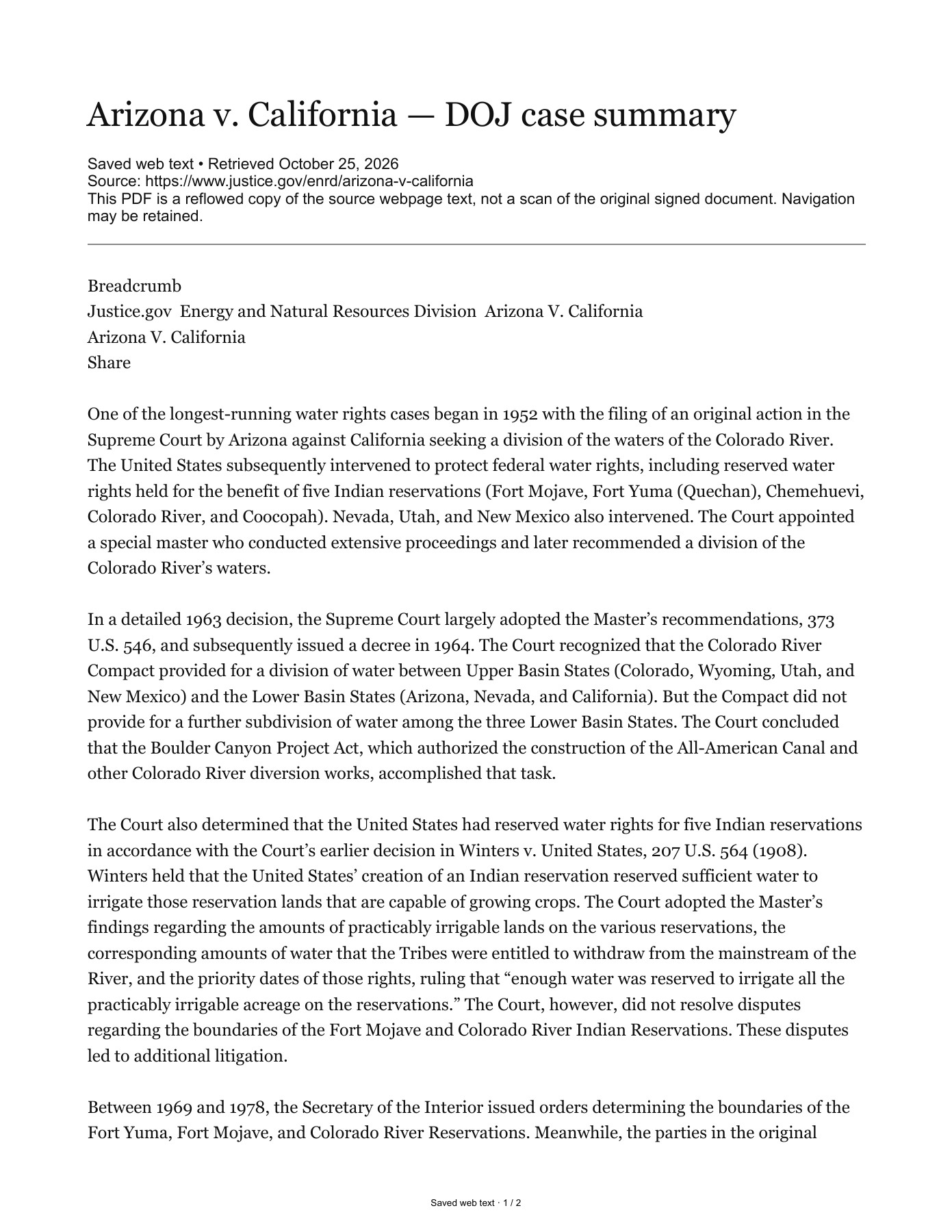
The Department of Justice's overview of Arizona v. California gives readers a compact account of one of the federal government's long-running water cases. It connects the interstate dispute, reserved water for Indian reservations, contested boundaries, supplemental decrees, and the eventual Quechan settlement. As an agency explanation, it is useful background. As a timeline, it needs to be checked against the underlying court documents. [1]
Two points in the summary require correction. It places approval of the Fort Mojave and Colorado River settlements in 1989, while the primary record places approval of those proposed settlements in the June 2000 opinion and entry of the supplemental decree in October 2000. It also describes Supreme Court approval of the Quechan settlements in 2005, while the Court's final order states that approval and entry of the consolidated decree occurred on March 27, 2006. [2] [3] [4] [5]
The overview reflects DOJ's account of the litigation and the federal government's involvement. Its chronology compresses a much longer sequence of motions, recommendations, opinions, and decrees. The dated judicial records distinguish those stages more precisely: reopening a proceeding, approving a proposed settlement, and entering operative terms were separate actions. That sequence is essential to understanding how the additional Fort Yuma claims eventually reached resolution.
The broader interstate dispute
DOJ begins with Arizona's 1952 original action against California over the use of Colorado River water. It describes the United States' intervention to protect federal rights, including reserved rights for five Indian reservations, and the participation of other states. The Supreme Court's later opinion and decree provide the fuller procedural history behind that overview. [1] [2] [5]
The breadth of the case explains why the Quechan record contains documents with a caption naming states rather than the Tribe alone. The reservation's additional water claims were litigated within a larger proceeding governing a river system and multiple parties. A document's caption therefore does not fully reveal every interest addressed inside it.
The summary also connects the 1963 decision with the 1964 decree. That distinction is useful: the opinion explains legal reasoning, while the decree states operative terms. Later phases followed a similar pattern of reports, opinions, agreements, and implementing orders, each performing a different function within the same case.
Reserved rights linked water to reservation lands
The overview explains that the Court recognized federal reserved water rights for the reservations and used practicably irrigable acreage in quantifying them. That relationship supplies the bridge between a dispute over land and a claim for additional water. If the reservation's legally relevant acreage changed or remained disputed, the water consequences could become a subject of further proceedings. [1] [2]
The Court's 2000 opinion provides the more precise account of the earlier decisions and the categories of later claims. It distinguishes lands omitted from earlier requests within recognized boundaries from lands whose reservation status was disputed. The distinction mattered to the application of finality and to what remained available for adjudication.
The agency summary helps a general reader see why nineteenth-century reservation instruments became relevant in a twentieth-century water case. It should not, however, be read as a comprehensive statement of reserved-rights law or a present determination of every use permitted under the decree. The primary decisions and terms provide that necessary detail.
Administrative action did not end the court proceedings
DOJ recounts Interior's boundary-related actions and the tribes' efforts to obtain additional water through the continuing litigation. The Court's account explains that the Secretary's determinations were not treated as final boundary determinations for the purposes then at issue because affected parties had not received the relevant opportunity for judicial review. [1] [2]
This procedural distinction is important. A federal administrative recognition could be historically consequential without automatically settling the quantity of water in an interstate decree. The legal effect of the administrative action within the judicial proceeding remained a question for that proceeding.
The Quechan sequence illustrates the point. The 1978 reversal and subsequent determination changed Interior's position on the disputed lands. The water claims nevertheless encountered further litigation over boundaries and preclusion. The summary is helpful when it connects those events, but the separate documents are needed to explain exactly what each action accomplished.
The 1989 event was reopening, not the later settlement decree
The primary record identifies October 10, 1989 as the date the Court granted the state parties' motion to reopen the decree to determine disputed boundary claims concerning Fort Mojave, Colorado River, and Fort Yuma. That reopening led to further proceedings before Special Masters. It was not the approval date for the later Fort Mojave and Colorado River settlements. [2] [5]
The Court approved the proposed settlements for those two reservations in its June 19, 2000 opinion and invited objections to the proposed supplemental decree. With no objections filed, it entered the decree on October 10, 2000. The two-page decree identifies the reservations and sets out the amended provisions. [3]
Correcting the overview's year matters because it restores the order of events. Reopening the case, conducting further proceedings, reaching agreements, approving them, and entering amended terms are separate milestones. Collapsing the later settlement into the reopening year makes the intervening litigation harder to understand.
Fort Yuma followed a different path in 2000
The Special Master had recommended that the Fort Yuma claims be barred by the earlier Claims Court settlement. The Tribe and the United States filed exceptions challenging that conclusion, while the state parties pressed a separate finality defense. The Supreme Court rejected the asserted barriers and remanded the outstanding claims. [2] [6]
The Court did not finally quantify the additional Fort Yuma entitlement in that opinion. The remand allowed further proceedings, which eventually produced the negotiated agreements. That is why the October 2000 decree concerning the other reservations is not the final Quechan settlement instrument.
DOJ's overview captures the broad fact that the Tribe was allowed to pursue the claim. The primary opinion adds the essential explanation: two different preclusion grounds failed for different reasons, and the claims returned to the Special Master. That detail distinguishes a procedural victory from the final terms negotiated afterward.
The 2005 and 2006 milestones should remain separate
The Special Master's final settlement recommendations were submitted June 14, 2005 and included separate California and Arizona agreements. Those materials explain the negotiated diversion quantities, timing, conditions, and qualified treatment of boundary issues. They are the source for understanding what was proposed for approval. [4]
The Court's March 27, 2006 decree expressly approves the final agreements and enters the consolidated decree. Its historical introduction also identifies the 2005 report and the parties' later joint motion. This direct statement supplies the approval date that should be used when describing the final judicial action. [5]
The overview gives 2005 for approval, while the decree expressly records the Court's final action in March 2006. The documents establish the two stages without explaining the reason for the overview's wording. The distinction places the report in the recommendation phase and the decree in the judicial implementation phase, preserving the interval between the proposed resolution and the Court's entry of the final instrument. [4] [5]
A rounded quantity needs its underlying terms
The overview says the settlements provided more than 26,000 acre-feet annually. The settlement report explains the components: up to 20,000 additional acre-feet under the California arrangement and up to 6,350 under the Arizona arrangement, with timing and other conditions. The California amount included a later stage beginning in 2025. [1] [4]
The rounded summary is useful for scale but insufficient for the full arrangement. It does not identify which quantity became available when, how Metropolitan could receive certain water, or the qualifications associated with the agreements. Those details belong to the settlement documents and the decree that approved them.
Nor does the figure establish actual water use in any given year. A negotiated entitlement, a diversion opportunity, and a measured delivery are different facts. The overview describes the legal outcome at a high level; operational questions require the relevant accounting records rather than inference from the settlement headline.
What an agency overview can and cannot prove
The DOJ page records the Department's public explanation of the case and identifies the involvement of its Indian Resources Section in the negotiations. That institutional perspective is part of its value. It helps readers understand the federal government's role across decades of litigation. [1]
The federal government's institutional account differs from the Tribe's own filings and from the state parties' arguments. Each describes a position or role within the same litigation. The Court's opinions and decrees then record the judicial reasoning and dispositions. The differences among those documents reflect the adversarial and procedural history of the case, rather than a single account shared by every participant.
The DOJ overview carries a June 6, 2023 update date. As a later public account, it looks back across the litigation rather than participating in an individual stage as a brief, recommendation, or decree. Its discussion of the Indian Resources Section connects the final settlements to the federal government's sustained involvement. The underlying judicial records establish the dates and operative terms of the actions the overview describes. [1]
The final Fort Yuma resolution followed several distinct developments: Interior's changed position on the disputed lands, further proceedings over boundary-related water claims, the defeat of threshold defenses, and negotiations producing separate agreements. DOJ's concise account brings those developments into a broad institutional narrative. The sequence of original decisions and agreements shows why recognition, permission to pursue a claim, and final settlement were each consequential steps rather than interchangeable descriptions of one event. [2] [4] [5]
Sources
1. Arizona v. California, DOJ ENRD case summary; updated June 6, 2023. DOJ Environment and Natural Resources Division overview; updated June 6, 2023. Download PDF · Source publication · PDF copy of published webpage (2 pages).
2. Arizona v. California, 530 U.S. 392 (2000). 530 U.S. 392; procedural history, preclusion rulings, and approval of proposed settlements. Read source PDF · Source publication
3. Arizona v. California, 531 U.S. 1–2 (2000), supplemental decree entered October 10, 2000. 531 U.S. 1–2; decree entered October 10, 2000. Read source PDF · Source publication
4. Arizona v. California, No. 8, Original, Special Master’s Approval of Final Settlements and Recommendations (June 14, 2005). Recommendations submitted June 14, 2005. Read source PDF · Source publication
5. Arizona v. California, 547 U.S. 150 (2006), decree entered March 27, 2006. Final agreements approved and consolidated decree entered March 27, 2006. Read source PDF · Source publication
6. Arizona v. California, No. 8, Original, Exception of the United States and Brief in Support (December 1999). Federal exception and supporting brief. Read source PDF · Source publication