

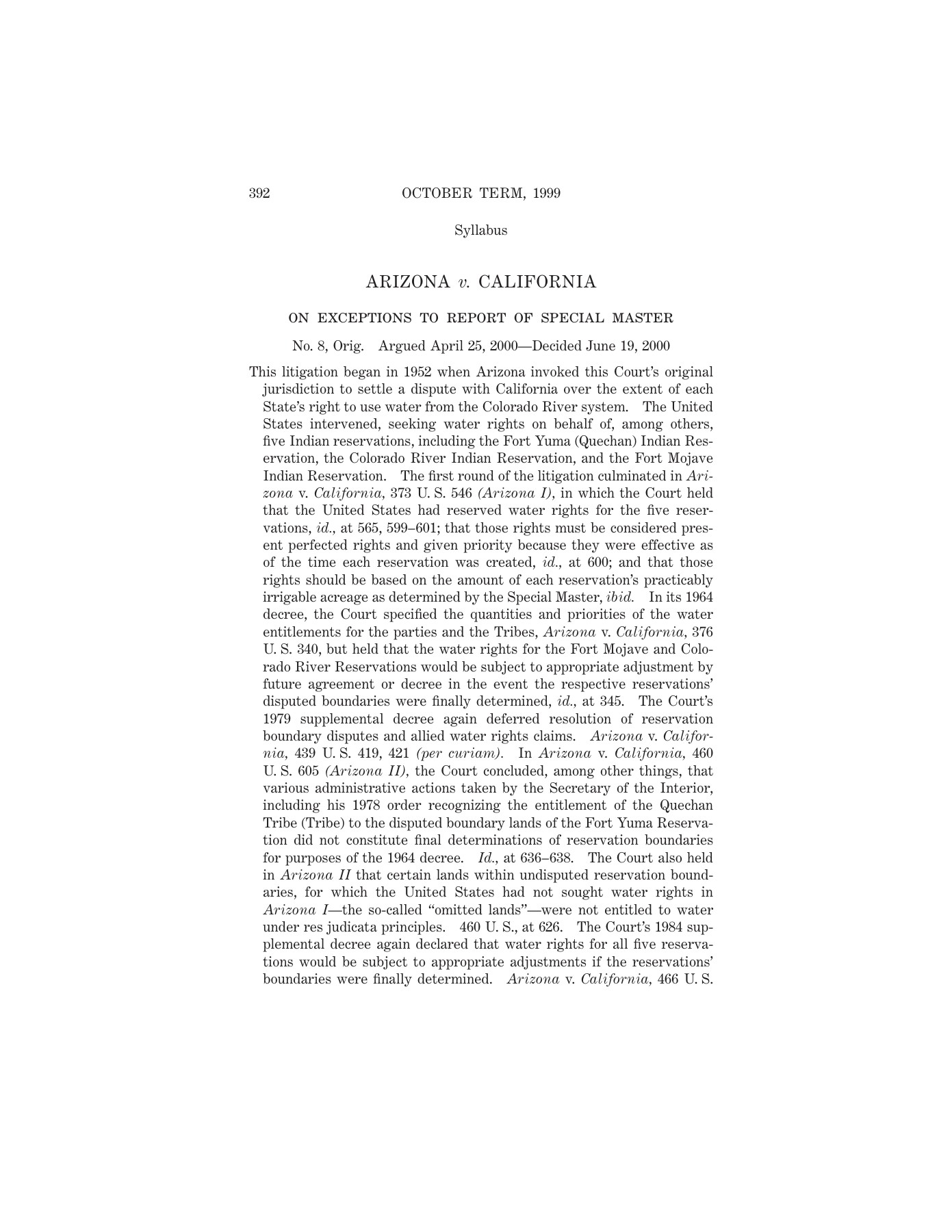
On June 19, 2000, the Supreme Court ruled that two asserted grounds for preclusion did not bar additional water-rights claims associated with disputed Fort Yuma reservation lands. The decision allowed the Quechan Tribe and the United States to continue pursuing the claims before the Special Master. It was a significant procedural victory, but it was not the final quantification and settlement of the disputed water entitlement. [1]
Justice Ruth Bader Ginsburg wrote the majority opinion. The Court considered both the earlier Arizona v. California litigation and a 1983 Claims Court consent judgment settling the Tribe's case against the United States. The Special Master had rejected the first asserted bar and accepted the second. The Court rejected both as grounds for ending these claims and remanded the outstanding issues. [1]
Permission to proceed was different from final relief. The June decision recounted the reservation's legal history in detail, but its Fort Yuma disposition was a remand for further proceedings on the outstanding claims. At the same time, the Court approved separate proposed settlements involving other reservations. The opinion therefore advanced several parts of the litigation without resolving them all in the same way or on the same timetable.
Why land history entered a water case
The additional claims rested on the position that the reservation included approximately 25,000 acres of disputed boundary lands not attributed to it in earlier stages of the litigation. Reservation acreage mattered because earlier decisions had quantified reserved water with reference to practicably irrigable acreage. The status of the land therefore connected to the possible quantity of additional reserved water. [1]
The Court recounted the 1893 agreement, the ratifying legislation, and Interior's changing interpretations. Margold's 1936 opinion treated the non-irrigable lands as ceded; Interior later reversed that position through the 1978 opinion and Secretarial action. The judicial narrative placed that administrative history within the longer dispute over reservation boundaries and additional water. [1] [5]
The opinion did not treat the administrative action as automatically resolving every issue in the water case. Earlier proceedings had held that the Secretary's action was not a final boundary determination for purposes of the decree. This meant that the land and water questions still had to proceed through the litigation's established framework.
Two different preclusion defenses
The state parties relied on two earlier proceedings. First, they argued that the original Arizona v. California decision and decree barred additional claims that the United States could have asserted then. Second, they argued that the Claims Court settlement had extinguished the Tribe's claim to the disputed lands and therefore prevented associated water claims. [1]
Those arguments involved different histories and legal mechanisms. The first concerned finality within the continuing interstate water case. The second concerned the effect of a separate negotiated judgment between the Tribe and the United States. Treating them as one generic objection would conceal why the Court analyzed each independently.
The December 1999 briefs reflect that division. The state parties excepted to the Master's rejection of the first defense. The United States and the Tribe separately challenged his acceptance of the second. The resulting opinion answered the distinct questions presented by those filings. [2] [3] [4]
The procedural posture also explains why the opinion contains an unusually substantial historical account. The Court needed to identify what earlier proceedings had addressed, what had remained unresolved, and what the settlement could fairly be said to have decided. History was not decorative background. It was part of evaluating the proposed barriers. Yet recounting that history did not convert this threshold decision into a final adjudication of every event or claim described in it. [1]
The earlier water-case defense came too late
The majority rejected the state parties' reliance on the earlier water litigation because they had failed to raise that preclusion argument earlier despite ample opportunity and reason to do so. It examined the supplemental decrees and the course of the litigation, including the treatment of boundary issues as matters remaining available for resolution. [1]
The ruling therefore depended on the particular procedural history. It was not a general declaration that judgments allocating water can always be reopened without regard to finality. The Court concluded that these parties could not deploy this defense at this stage after the case had proceeded as it had.
The Court also declined to raise the defense on its own initiative. It found no special circumstances requiring that step. The practical result was that the earlier Arizona v. California judgment did not provide the requested threshold bar to the outstanding Fort Yuma claims.
The $15 million settlement did not decide every issue
The second defense concerned Docket No. 320, the Tribe's earlier claims case against the United States. That case had involved alternative theories, including an invalid agreement and trespass-type injury on one hand, and an uncompensated taking on the other. The 1983 settlement resolved the claims for $15 million without requiring the Tribe to elect one of those mutually exclusive theories. [1]
The Master had treated the consent judgment as extinguishing the Tribe's claim to title and therefore defeating the additional water claims. The Court disagreed. It distinguished the settlement's claim-preclusive effect between the settling parties from issue preclusion in the later proceeding. A settlement does not ordinarily establish that every disputed underlying issue was actually litigated and decided.
The ambiguity mattered. Because the settlement embraced alternative theories without selecting one, it did not conclusively establish the historical premise needed for the asserted bar. The Court found the consent judgment too indeterminate to serve that function. The fact of payment alone did not supply the missing adjudication.
The Court did not adopt every argument offered for that result
The United States had invited the Court to look behind the judgment to materials said to demonstrate a shared understanding that the Tribe owned the lands. The Court explained that it did not need to accept that invitation to reject issue preclusion. The judgment's ambiguity between the mutually exclusive theories was sufficient. [1] [2]
This is an important limit on the holding. A party can win a requested result without the Court adopting every element of its narrative or every route it proposes. The federal and tribal briefs remain important evidence of advocacy, but the opinion's stated reasoning controls the description of what the Court decided.
The Court likewise did not need to settle every possible question about the preclusive force of every Indian claims judgment. Its analysis addressed this consent judgment and this record. That specificity is part of what makes the decision useful: it identifies why the particular asserted barrier failed without turning the case into an unlimited rule about all settlements.
The justices disagreed about finality
Chief Justice Rehnquist wrote separately, joined by Justices O'Connor and Thomas, disagreeing with the majority's rejection of the state parties' earlier-litigation defense. He emphasized certainty in western water rights and concluded that the United States could have raised the boundary claim in the original case. On that view, further proceedings on the Fort Yuma claims were unnecessary. [1]
The separate opinion makes the dispute within the Court visible. The majority's ruling governed, but the alternative analysis reflected a different assessment of the litigation history and the force of finality. It should be identified as a separate, noncontrolling position when discussed or quoted.
The published decision includes the majority's reasoning, a proposed decree, and a separate opinion reflecting disagreement within the Court. Those portions performed different functions. The majority's disposition returned the outstanding Fort Yuma claims for further proceedings; the separate opinion explained a competing view of finality. The proposed decree addressed the settlements for other reservations rather than a final additional Fort Yuma allocation.
Other reservations followed a different procedural path
The Court also approved proposed settlements concerning the Fort Mojave and Colorado River reservations and called for objections to the proposed supplemental decree. Those settlements were separate from the unresolved Fort Yuma claims. The case could therefore move toward a decree for some reservations while returning another reservation's claims for further proceedings. [1]
The supplemental decree was later entered on October 10, 2000, at 531 U.S. 1–2. Its operative amendments concern Fort Mojave and Colorado River. It is not a second version of the June opinion or the final Fort Yuma settlement decree. [6]
Keeping those documents distinct prevents a common chronological error. The shared case name and the same calendar year do not make the decisions interchangeable. The June opinion explains the preclusion rulings; the October decree implements the separate settlements; the Fort Yuma resolution appears in later records.
The remand opened the next chapter
After the June decision, the outstanding Fort Yuma claims returned to the Special Master. The subsequent record includes further discovery, preparation for hearing, and negotiated settlements submitted in 2005. The Court approved the final agreements and entered a consolidated decree on March 27, 2006. [7] [8]
The 2000 decision's significance is therefore both substantial and bounded. It removed legal barriers that otherwise would have ended the claims, preserving the opportunity for a merits resolution or settlement. It did not itself award every additional acre-foot requested or settle every land-title and jurisdictional question associated with the reservation.
Read at that scale, the opinion is a pivotal document. It connects nineteenth-century reservation instruments, twentieth-century administrative reconsideration, a damages settlement, and the procedural rules governing a long-running water case. Its conclusion kept the Fort Yuma claims alive—and the later settlement history shows why that opportunity mattered.
Sources
1. Arizona v. California, 530 U.S. 392 (2000). Arizona v. California, 530 U.S. 392; majority opinion, pages 397–419; separate opinion, pages 422–427. Download PDF · Source publication · Source PDF (36 pages).
2. Arizona v. California, No. 8, Original, Exception of the United States and Brief in Support (December 1999). Exception and supporting brief. Read source PDF · Source publication
3. Arizona v. California, No. 8, Original, Exception of the Quechan Indian Tribe to the Report and Recommendation of the Special Master and Supporting Memorandum (December 20, 1999). Exception and supporting memorandum. Read source PDF · Source publication
4. Arizona v. California, No. 8, Original, Exception by State Parties to Report of Special Master and Supporting Brief (December 20, 1999). Exception and supporting brief. Read source PDF · Source publication
5. M-36908 (December 20, 1978), published at 86 I.D. 3–22 (1979). M-36908; 86 I.D. 3–22. Read source PDF · Source publication
6. Arizona v. California, 531 U.S. 1–2 (2000), supplemental decree entered October 10, 2000. Separate decree entered October 10, 2000; 531 U.S. 1–2. Read source PDF · Source publication
7. Arizona v. California, No. 8, Original, Special Master’s Approval of Final Settlements and Recommendations (June 14, 2005). Final settlement recommendations submitted June 14, 2005. Read source PDF · Source publication
8. Arizona v. California, 547 U.S. 150 (2006), decree entered March 27, 2006. Final approval and decree entered March 27, 2006. Read source PDF · Source publication