


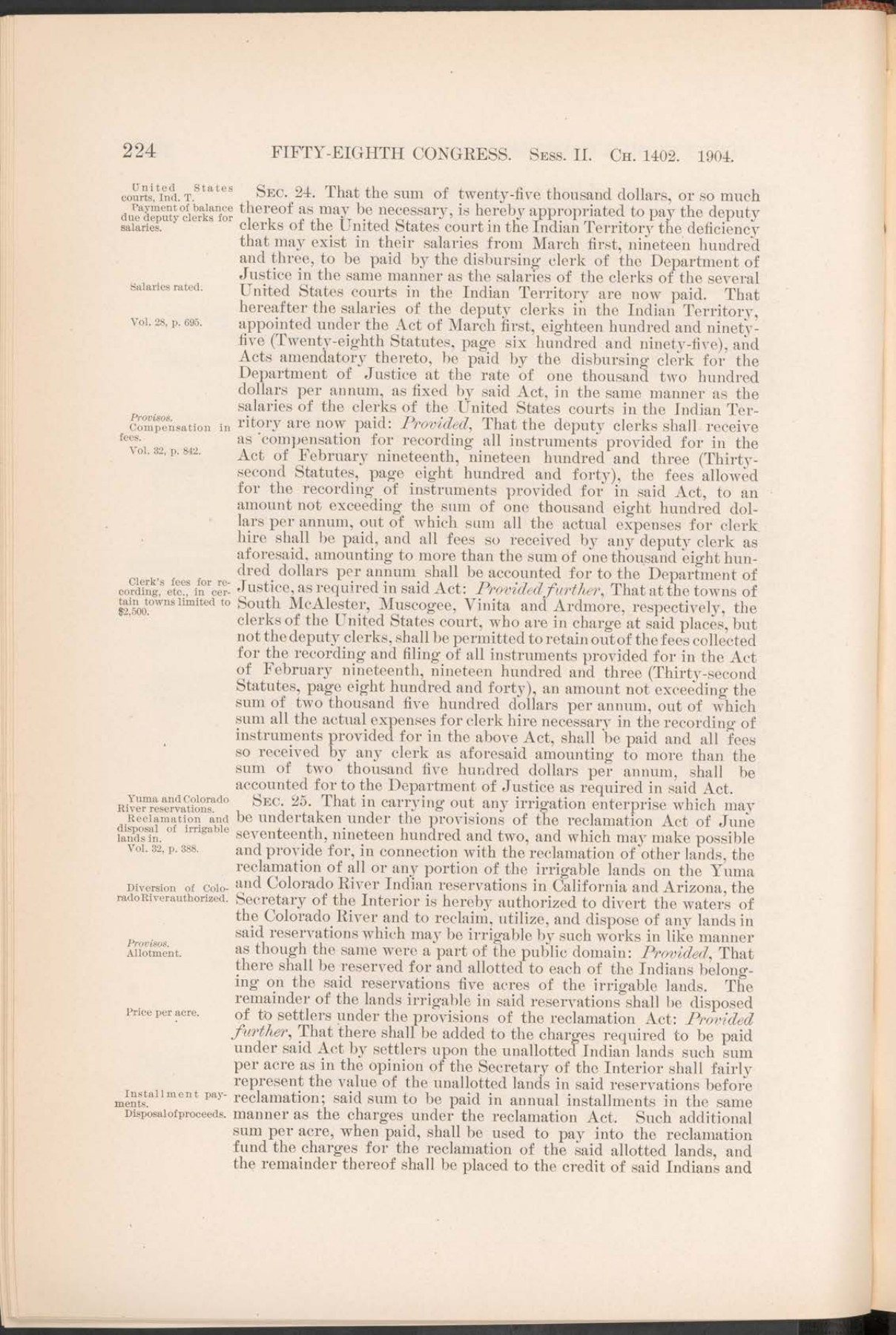
A decade after Congress ratified the Yuma agreement, it enacted a new provision addressing irrigation on the Yuma and Colorado River reservations. Section 25 of the April 21, 1904 act authorized Interior to divert Colorado River water and reclaim, use, and dispose of reservation lands irrigable through enterprises under the 1902 reclamation law. The provision retained five-acre allotments for Indians belonging on the reservations while directing the disposition of remaining irrigable lands through the reclamation framework. [1]
The law matters for two related reasons. It supplied an express mechanism for a new agricultural development program. It also became a central point in the later argument over the 1893 agreement: did subsequent irrigation and allotment under this law complete the earlier conditional arrangement, or did the 1904 statute establish a different program with different consequences? Interior's opinions eventually answered that question differently. [4] [5] [6]
A careful account must begin with what section 25 actually says. It concerns irrigable land, reclamation enterprises, allotments, settler charges, and the use of money. It does not reproduce the eight articles of the 1893 agreement or expressly declare that every obligation under that agreement had been fulfilled. The relationship between the two arrangements was an interpretive question later officials had to confront.
A regional irrigation enterprise
The section applies when an enterprise undertaken under the June 17, 1902 reclamation act could make possible irrigation of reservation lands in connection with reclamation of other lands. The statutory framing therefore places the reservations within a larger water-development undertaking. It is not limited to a small standalone project serving only individual reservation allotments. [1]
Interior received authority to divert Colorado River water and reclaim, utilize, and dispose of lands irrigable by those works in the manner specified. The phrase linking disposition to treatment as public-domain land was part of that grant of operational authority. Its presence cannot be ignored, but it also cannot be detached from the section's focus on land irrigable through the contemplated works.
The distinction between authority over irrigable lands and the disputed status of non-irrigable lands later became decisive. The 1978 opinion emphasized that the latter lands were not practically affected by the 1904 program in the way required to complete the earlier cession. The statutory text was thus read within a dispute about categories of land as well as the government's subsequent conduct. [6]
Five-acre allotments remained in the scheme
Section 25 required reservation of five acres of irrigable land for allotment to each Indian belonging on the covered reservations. That amount resembled the individual allotments contemplated in the 1893 agreement. The similarity provided one connection between the earlier arrangement and the later statute, and later analysis considered its significance. [1] [2] [5] [6]
Similarity, however, did not eliminate the need to compare the rest of the terms. The earlier agreement contained its own procedures for selection, approval, appraisal, sale, and handling of proceeds. The later statute located disposal of remaining irrigable lands within the reclamation law. Whether one program implemented the other could not be settled simply by observing that both referred to five acres.
The allotment provision also shows that the 1904 law contemplated protected individual selections before disposal of the remainder to settlers. It did not authorize disposition of all irrigable acreage without reservation for the Indians described in the section. The relationship between retained allotments and lands available to settlers was part of the program's design, not an optional administrative afterthought.
Settlers faced an additional land charge
For settlers taking unallotted Indian lands, the statute added a charge beyond the ordinary reclamation charges. Interior was to determine a per-acre amount fairly representing the value of the unallotted land before reclamation. The settlers would pay that amount in annual installments in the same manner as the reclamation charges. [1]
That provision distinguished the underlying land value from the cost associated with making water available through the reclamation project. The distinction matters when comparing the 1904 program with the earlier proposal to appraise and sell irrigable tracts for cash. Different payment structures can produce different timing, revenue, and financial obligations, even where both programs ultimately involve farming and land disposal.
The statute did not state a single dollar figure applicable to every acre. It assigned the valuation judgment to the Secretary. Nor did authorization of installment payments establish that every expected payment was received. The law supplies the financial mechanism; project and accounting records would be needed to reconstruct actual collections and expenditures over time.
Where the additional money was to go
The additional per-acre money was first to pay into the reclamation fund the reclamation charges for the allotted lands. Any remainder would be credited to the Indians and spent for their benefit under Interior's direction. The section's final words appear on printed page 225, making that page necessary to read the complete provision. [1]
This order of application is a major reason the 1904 law cannot be summarized as identical to the 1894 arrangement. The earlier plan contemplated sale proceeds credited to a fund earning five percent interest and applied to specified purposes. The later statute directed the additional receipts first toward the reclamation charges on allotted lands, with a remainder available for the Indians' benefit. [2] [3]
Krulitz highlighted these differences in 1978. In his account, the different treatment of sale proceeds, construction costs, and interest undermined the claim that the later program had simply carried out the earlier agreement. His conclusion was an interpretation of the relationship between the instruments, but it rested on concrete differences readers can inspect in the statutes themselves. [6]
The direction also distinguishes a charge assessed from money actually paid. The statute described how additional receipts were to be applied when collected. It did not promise that an anticipated land valuation would immediately appear as an available balance for the Tribe. That timing helps explain why the financial mechanics deserve attention alongside the better-known authorization to construct and operate irrigation works. [1]
The earlier canal arrangement was not the same text
The 1894 ratification addressed a canal right of way previously granted to the Colorado River Irrigating Company. It required construction to begin within three years on pain of forfeiture of the granted rights. It also included a limited provision for rent-free water on one acre of a qualifying adult man's allotment for ten years after delivery began. [3]
The 1904 section instead invokes the federal reclamation act and an enterprise connected to the reclamation of other lands. That contrast helps explain the historical problem. Irrigation could eventually arrive under a later statutory program without answering, merely by its arrival, every question about performance of a different earlier agreement.
The competing Interior opinions were concerned with that legal consequence. Margold's 1936 account treated the government's later actions and accepted benefits as supporting the conclusion that the earlier arrangement had operated to extinguish title. Austin's 1977 opinion maintained the adverse title conclusion. Krulitz later rejected the interpretation that the 1904 act implemented the cession on the necessary terms. [4] [5] [6]
Non-irrigable land remained the disputed category
The controversy was not simply whether farming or irrigation development occurred somewhere on the reservation. It concerned what happened to title in the disputed non-irrigable acreage. The 1893 agreement and 1894 statute had separately addressed that category, including opening through presidential proclamation under the general land laws. Section 25's reclamation program was framed around lands irrigable through the works it authorized. [1] [2] [3]
Krulitz concluded that Congress's awareness of the earlier agreement did not itself prove an intention to complete its conditional cession through the 1904 law. He considered the text, legislative history, and administrative practices and found the contrary interpretation more persuasive. In his analysis, authority to undertake reclamation and dispose of irrigable land did not necessarily depend on effectuating the earlier cession of non-irrigable lands. [6]
The point is important because it separates an observable development program from a disputed legal inference about other property. A history of irrigation infrastructure and a history of reservation title intersect here, but they do not become identical. The documents need to show the asserted connection, and the later opinions need to be identified as competing interpretations rather than blended into a single unchanging federal view.
A short section with a long afterlife
Section 25 placed allotments, settlement charges, and the disposition of receipts within a reclamation arrangement. Its final direction concerning the remainder of the receipts forms part of that financial structure, alongside the provisions governing land and water. The act's importance to the later controversy lay in the relationship among those terms. A program involving irrigation and five-acre allotments could resemble the earlier proposal while still distributing costs and proceeds under a different statutory design. [1]
This page presents the 1904 enactment itself. Later amendments and the full history of project implementation are not reproduced in that excerpt. Consequently, its five-acre provision and financial directions should be understood as the text Congress adopted at that time, not as a claim that no later law or administrative action changed the program.
Its enduring place in the Quechan record comes from the question it forced later officials to answer. Did a new irrigation program satisfy the old agreement's conditions, or did those conditions remain unfulfilled? The 1904 text makes that question concrete. It reveals an actual statutory structure—regional reclamation, individual allotments, settler charges, and a particular destination for receipts—against which the later legal arguments can be measured.
Sources
1. Act of April 21, 1904, ch. 1402, § 25, 33 Stat. 189, 224–225. Act of April 21, 1904, section 25; 33 Stat. 224–225. Download PDF · Source publication · Source PDF excerpt (2 pages).
2. Agreement of December 4, 1893; S. Exec. Doc. No. 68, 53d Cong., 2d Sess., pp. 19–22 (1894). Articles II–VI. Read source PDF · Source publication
3. Act of August 15, 1894, ch. 290, § 17, 28 Stat. 286, 332–336. Section 17; 28 Stat. 332–336. Read source PDF · Source publication
4. M-28198 (January 8, 1936), Opinions of the Solicitor Relating to Indian Affairs, vol. 1, pp. 596–601. Analysis of the agreement and later allotments; pages 598–601. Read source PDF · Source publication
5. M-36886, 84 I.D. 1–54 (January 18, 1977). Analysis of the 1904 act; 84 I.D. 1–54. Read source PDF · Source publication
6. M-36908 (December 20, 1978), published at 86 I.D. 3–22 (1979). Discussion of the 1904 act; particularly 86 I.D. 19–22. Read source PDF · Source publication