


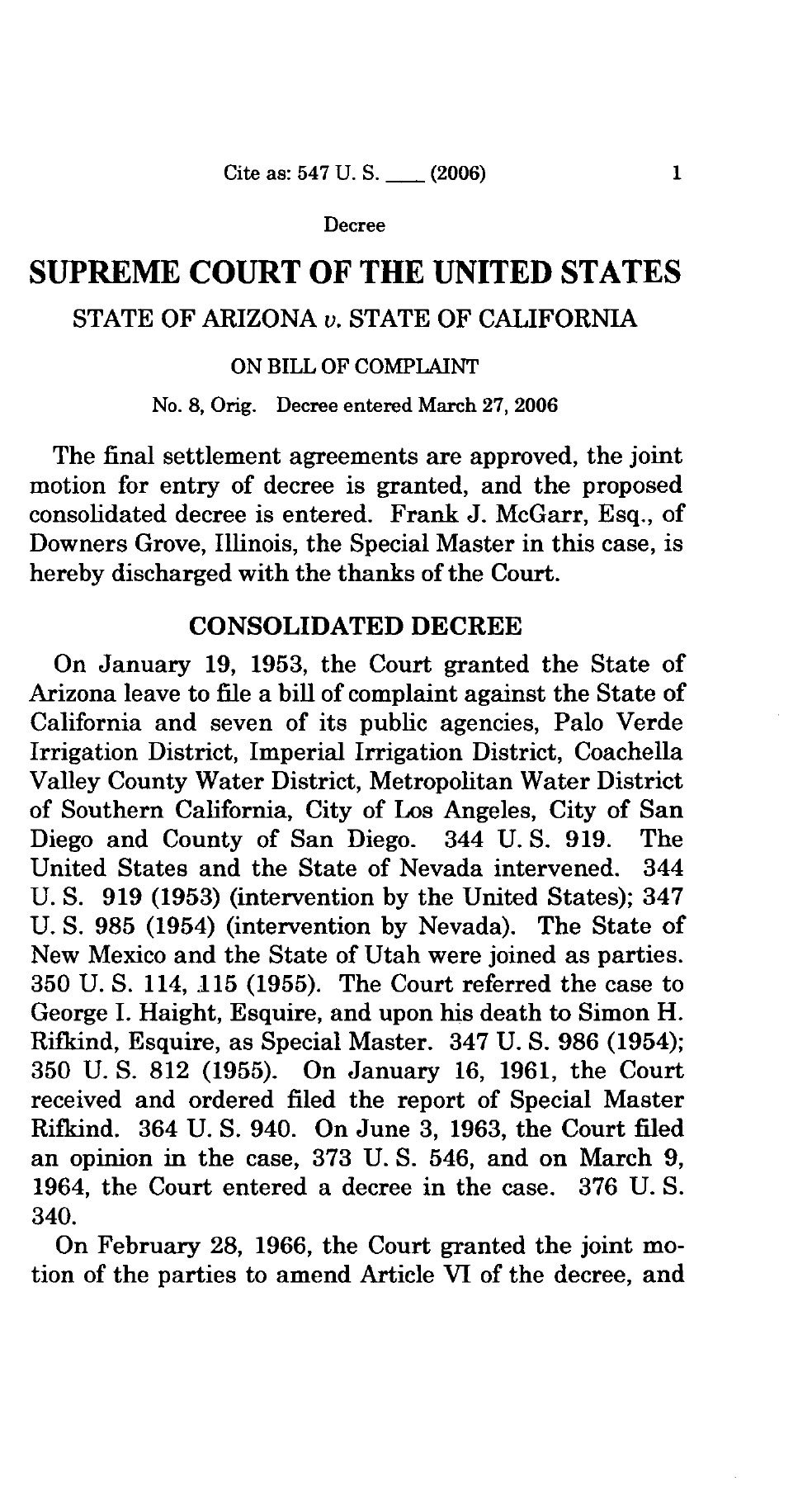
On March 27, 2006, the Supreme Court approved the final settlement agreements in Arizona v. California and entered a consolidated decree. The opening order is direct: the agreements were approved, the joint motion was granted, and the proposed consolidated decree was entered. The Court also discharged Special Master Frank J. McGarr with its thanks. This is the primary document for the final approval date of the Fort Yuma settlement. [1]
The decree did two kinds of work at once. It implemented the settlements of the Fort Yuma reserved-water claims and consolidated substantive provisions from earlier decrees in the long-running Colorado River case. Its explanation states that the purpose was to provide a single convenient reference for the rights and obligations adjudicated in the proceeding, while preserving earlier provisions except where the new text changed them.
The decree did more than announce a settlement: it incorporated operative water provisions into the continuing interstate adjudication. Its scope nevertheless remained tied to that proceeding. The water decree, settlement agreements, and earlier boundary instruments addressed related but distinct questions. Approval of the negotiated water arrangements did not turn the consolidated decree into an unrestricted determination of every title or jurisdictional issue involving the reservation.
The route from remand to approval
The June 2000 opinion had rejected two grounds for barring the additional Fort Yuma claims and returned them to the Special Master. It did not finally award the disputed water. Further proceedings led to the California and Arizona agreements submitted with the Master's June 2005 recommendations. [2] [3]
The 2006 decree's own historical introduction identifies those steps. It distinguishes the 2000 settlements for Fort Mojave and Colorado River from the Fort Yuma remand, then records the 2005 recommendation and the parties' joint motion for a consolidated decree. This chronology is particularly useful because all of the records share the same general case caption.
The recommendation and final approval occurred in different years. The Special Master submitted the settlement report in June 2005; the Court approved the final agreements and entered the consolidated decree in March 2006. The sequence gave the negotiated terms their judicial implementation after the recommendation stage. The dated decree identifies the action by which the Court adopted the final arrangements within the ongoing case. [1]
Consolidation did not restart every obligation
The decree says that, except where its text differs from previous decrees, it does not vacate or alter their substantive provisions. Earlier mandates and obligations remain effective from their respective dates of entry. References to previous decrees in other instruments are to be understood through the corresponding provisions of the consolidated text. [1]
This preserves continuity. A reader should not assume that every right listed in the 2006 document first arose in 2006. Much of the decree carries forward an earlier adjudicated framework, including priority dates and provisions originating in previous stages of the case. The new document combines that framework with the settlement changes.
The October 2000 decree is one of the earlier instruments incorporated into this sequence. It had amended provisions for Fort Mojave and Colorado River. The consolidated decree brings those amendments into the same reference while also implementing the later Fort Yuma resolution. The earlier dates remain part of the legal history. [4]
The principal Fort Yuma paragraph
Article II(D)(3) states a Fort Yuma annual limit using two measures: 77,966 acre-feet of mainstream diversions, or the quantity needed to supply consumptive use for irrigation of 11,694 acres and related uses, whichever is less. It identifies January 9, 1884 as the priority date. The whole formulation matters; the diversion number alone is not the complete provision. [1]
The appendix separates the listed rights by state. The later 2018 study reproduces the decree-based table as 6,350 acre-feet and 952 net acres in Arizona, and 71,616 acre-feet and 10,742 net acres in California, totaling the figures in the principal paragraph. The study also repeats the qualification concerning diversions or the corresponding consumptive-use measure. [5]
These are adjudicated terms and their later study presentation, not measurements of annual use. Actual diversions, return flows, and consumptive use require accounting records. Treating the authorized figure as a report of what was physically used in a given year would confuse a legal entitlement with operational evidence.
The California agreement must be read alongside the table
The final agreements approved by the decree include the California arrangement for additional diversions of up to 20,000 acre-feet annually, staged as 13,000 upon the required decree and a further 7,000 beginning in 2025. The Master's report explains the conditions and the mechanism by which Metropolitan could receive water if the Tribe limited use and allowed it through California's priority system. [2]
Those terms should not be reconstructed by taking a number from the decree's main table and casually adding every figure found elsewhere. The approved settlement, decree provisions, state accounting, and conditions serve different functions. A responsible explanation identifies which instrument supplies each quantity and what qualifications accompany it.
The 2018 study discusses the Metropolitan mechanism separately from its decree-based table. That organization reflects the different components of the water arrangements. The study describes rights, quantities, and mechanisms as part of its historical account; it does not establish actual deliveries after its study period. A negotiated opportunity for water use and a record of water actually delivered concern different events. [5]
Diversion and consumptive use are different measures
The decree defines consumptive use by reference to diversions less qualifying return flow. That definition explains why the document repeatedly distinguishes water taken from the mainstream from water consumed under the specified accounting framework. A single acre-foot figure can be misleading unless its measure is identified. [1]
The distinction is particularly relevant when comparing legal entitlements with later agricultural or municipal use estimates. A report may describe diversions, consumptive use, deliveries, or projected demand. Those quantities are related, but they are not automatically interchangeable. The decree supplies definitions and operative limits that must remain attached to its numbers.
The appendix also explains that the irrigation-based measure is a means of determining the quantity of adjudicated rights, not a restriction requiring all use to remain agricultural. It sets corresponding consumptive-use limits for other uses. That qualification prevents a simplistic reading that the presence of an irrigable-acreage figure confines every use of the right to farming. [1]
Recordkeeping is part of the decree
Article V requires the United States to prepare and maintain detailed records concerning releases, diversions, return flows, consumptive use, and other specified matters, and to make them available for inspection. The requirements are part of the decree's administration, not an incidental suggestion at the end of a historical narrative. [1]
This matters because adjudication and accounting answer different questions. The decree establishes rights and obligations; records of operations show how water moves within that framework over time. The existence of a decreed quantity does not eliminate the need to document actual use, and an annual use figure does not by itself redefine the entitlement.
The later water study draws on Reclamation's accounting reports for its historical use estimates. That is the appropriate kind of bridge from a legal instrument to a planning account. It also explains why a dated study cannot be presented as a substitute for current accounting when a reader wants to know what happened in a particular recent year. [5]
The decree also retains a mechanism for the parties to apply for further orders, directions, or modification under its terms. Its consolidated form was meant to make the adjudicated framework accessible, not to pretend that administration of a river system ends when a document is printed. The provisions for continuing records and judicial supervision belong alongside the quantities because they describe how the framework is to operate over time. [1]
Boundary compromises retained their qualifications
The settlement materials contain detailed provisions concerning recognition of the 1981 determination, specified riverbed lands, and reservations of legal positions. In California, the parties did not all adopt identical positions for every purpose. The report describes carefully framed commitments, including recognition for water-rights purposes and preservation of certain disagreements. [2] [6]
The decree's approval of those agreements should therefore be described through their terms. It does not justify a sweeping statement that every reservation boundary, private interest, or jurisdictional question was finally adjudicated against every possible party. The settlement resolved the matters covered by the negotiated instruments within this proceeding.
That precision does not diminish the resolution. It identifies what the parties achieved: defined water arrangements and an agreed framework sufficient to conclude the pending claims, even where they did not abandon every position in every other context. The distinction is central to understanding a negotiated settlement's historical significance.
The final instrument remains the reference point
The consolidated instrument joins the approval order with definitions, reservation-specific provisions, accounting duties, and state schedules. Its appendix places the Arizona and California quantities within that broader structure. The settlement agreements and the Master's report explain the negotiated arrangements that preceded approval. Together, those instruments connect the parties' undertakings to the terms entered by the Supreme Court in March 2006. [1] [2]
Together, those documents mark the endpoint of the settlement sequence covered here. The 2000 opinion kept the Fort Yuma claims alive; the 2005 materials set out the negotiated resolution; and the 2006 order approved the final agreements and entered the consolidated terms. The decree's importance lies in that concrete judicial action and the detailed framework it preserves, rather than in a broad label that obscures its provisions.
Sources
1. Arizona v. California, 547 U.S. 150 (2006), decree entered March 27, 2006. March 27, 2006 decree; opening order, Articles I, II(D)(3), V, IX, and Appendix A. Download PDF · Source publication · Source PDF (68 pages).
2. Arizona v. California, No. 8, Original, Special Master’s Approval of Final Settlements and Recommendations (June 14, 2005). California and Arizona agreements and recommendations. Read source PDF · Source publication
3. Arizona v. California, 530 U.S. 392 (2000). Rejection of preclusion and remand; 530 U.S. 392. Read source PDF · Source publication
4. Arizona v. California, 531 U.S. 1–2 (2000), supplemental decree entered October 10, 2000. October 10, 2000 amendments; 531 U.S. 1–2. Read source PDF · Source publication
5. Colorado River Basin Ten Tribes Partnership Tribal Water Study, Chapter 5.9: Quechan Indian Tribe (December 2018). Table 5.9-A and section 5.9.5.4. Read source PDF · Source publication
6. 46 Fed. Reg. 11,372–11,376 (February 6, 1981); signed January 30, 1981. Determination referenced in the settlement materials. Read source PDF · Source publication