


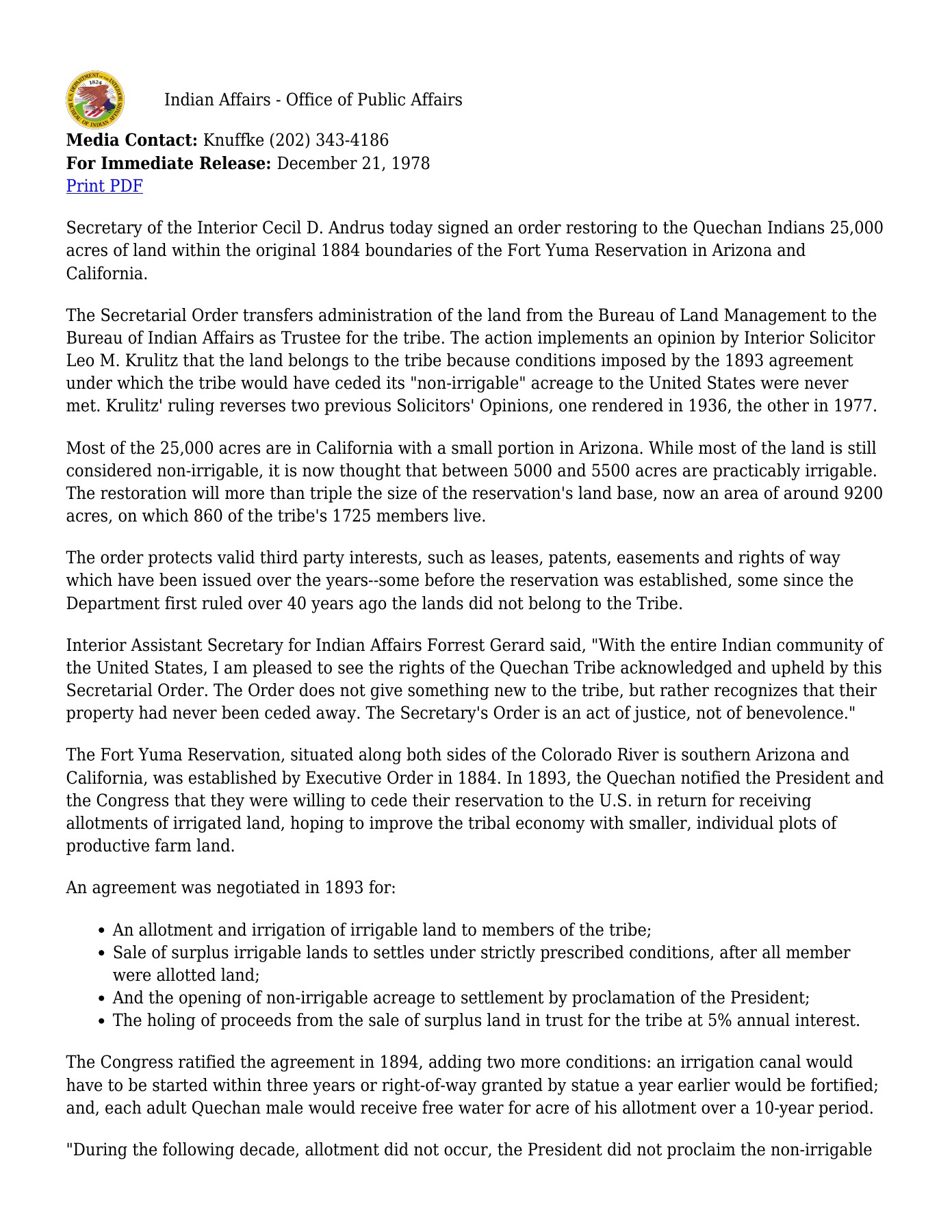
The Bureau of Indian Affairs announcement released in December 1978 presented a major change for the Quechan Tribe: Secretary Cecil D. Andrus had acted to recognize approximately 25,000 acres within the original Fort Yuma reservation boundaries. Administration would move from the Bureau of Land Management to the Bureau of Indian Affairs as trustee. The action followed Solicitor Leo Krulitz's conclusion that the conditions of the old cession arrangement had never been fulfilled. [1] [2]
The headline described land being restored. The body explained a more particular legal position: Interior was recognizing property it concluded the Tribe had never ceded away. That distinction is the announcement's central historical point. The Department was not presenting the action simply as a new gift of federal property. It was changing its interpretation of the Tribe's existing rights and adjusting administration to reflect that conclusion.
The press release compressed decades of agreement, legislation, opinions, and reconsideration into a public explanation of what the Secretary had done and why. It recorded the government's contemporary account of a major reversal. The Krulitz opinion supplied the detailed legal reasoning behind that change, and the later published determination set out the administrative directions through which recognition of the Tribe's interest would operate. [2] [5]
The scale described in the release
The agency described the affected land as roughly 25,000 acres, mostly in California with a smaller portion in Arizona. It compared that amount with an existing reservation land base of around 9,200 acres and said the recognition would more than triple that base. It also reported that 860 of the Tribe's 1,725 members lived on the reservation at the time. [1]
These figures are historical statements in a 1978 release. They are not current enrollment, population, or acreage measurements. Their value is to show how the agency represented the scale of the action at the moment it announced it. A modern article should preserve their date and attribution rather than silently update them into present-tense statistics.
The release further stated that most of the land was still considered non-irrigable, while approximately 5,000 to 5,500 acres were then thought practicably irrigable. That observation connects the land decision to the water-rights controversy that followed. It also shows why the old category of non-irrigable land did not exhaust every later assessment of agricultural potential. The release reported a contemporary view, not a final judicial award of water for that acreage.
The release's juxtaposition of land base, resident population, and potentially irrigable acreage served several purposes. It communicated the scale of the administrative recognition, identified the community to which the action related, and pointed toward possible agricultural significance. Those were different measures. Acreage did not measure membership, and a contemporary estimate of irrigation potential did not measure an already-adjudicated water right.
The later water litigation illustrates the distinction. The additional claims required a separate judicial route even after Interior recognized the land interest. The release supplied public context for that route, but it did not contain the later settlement's quantities, staged availability, or conditions. Those terms appear in documents produced after further litigation and negotiation. [6]
The administrative transfer had a reason
Moving administration from BLM to BIA was the practical counterpart of the changed title interpretation. Under the Department's newly stated view, the land was to be administered in trust for the Tribe rather than on the premise that the old cession had removed the Tribe's interest. The announcement tied the transfer directly to Krulitz's analysis. [1]
That relationship matters because a change of bureau can otherwise sound like an internal reorganization without consequences for the underlying rights. Here, the agency explained it as implementation of a legal conclusion about ownership and the failure of conditions. The institutional change and the historical interpretation were connected.
The press release reported the Secretary's action and its principal effects, while the legal reasoning appeared in the Solicitor's opinion. The later Federal Register determination supplied the detailed administrative directives, including recognition of trust status and treatment of particular interests. These were different forms of governmental action and communication. The announcement explains how Interior presented the reversal publicly; the opinion and determination establish the reasoning and implementation behind that account. [2] [5]
Why Interior said the land had not been ceded
The announcement summarized the 1893 arrangement as a plan for individual irrigated allotments, sale of surplus irrigable land under prescribed terms, opening of non-irrigable acreage, and retention of sale proceeds for the Tribe at five percent interest. It also described the additional irrigation-related provisions Congress included when ratifying the agreement. [1] [3] [4]
According to the release's explanation of Krulitz's opinion, the contemplated allotment, canal construction, and presidential opening did not occur during the following decade. Later irrigation and allotment proceeded under the 1904 reclamation law, which Krulitz regarded as a different arrangement rather than performance completing the earlier conditional cession. [2]
The announcement's recognition language followed Interior's conclusion that the required conditions had never been fulfilled. In the Department's account, the disputed land had not legally passed away through the earlier arrangement. The action acknowledged a continuing property interest rather than describing an ordinary new acquisition. Recognition nevertheless left further questions involving administration, protected interests, and water litigation to be addressed through the relevant instruments and proceedings.
Two earlier opinions were being reversed
The release identified the 1936 and 1977 Solicitor opinions as the positions Krulitz had overturned. It also recounted a period of reconsideration in the 1970s, including a draft favorable to tribal ownership, an unexpected decision maintaining the earlier position, controversy, and Senate hearings. This history gave the announcement an institutional context rather than presenting the reversal as spontaneous. [1] [2]
The exact dates and formal references are best taken from the opinions themselves. The published Austin opinion is dated January 18, 1977, even though the release's narrative uses a different day in recounting that episode. The Krulitz memorandum is dated December 20, 1978 and was subsequently printed under a January 1979 reporter heading. Distinguishing the formal documents from the announcement avoids turning minor inconsistencies in a compressed agency narrative into competing historical events.
The longer sequence is nevertheless clear. The Tribe challenged a federal interpretation adverse to its claimed title; the Department reconsidered and initially maintained that interpretation; a later Solicitor rejected it; and the Secretary acted on the new opinion. The release is valuable because it records how Interior explained that change publicly.
Existing interests were expressly protected
The agency emphasized that valid third-party interests would be protected. It named leases, patents, easements, and rights of way, including interests arising before the reservation's establishment and others created during the years when Interior treated the disputed lands as outside tribal ownership. The recognition was announced together with those protections. [1]
The release also stated that a lengthy list accompanied the Secretary's order and that the order provided an opportunity to correct erroneously described rights and add inadvertently omitted ones. The later 1981 notice explains that a complete list was compiled after third parties were notified and asked to submit claims. This is the documentary link between the initial announcement and the more detailed reissued determination. [5]
Those details prevent an oversimplified account of restoration as a complete reset of every interest within an outer boundary. The government's stated approach recognized the Tribe's title while addressing the interests accumulated over the intervening years. The protected interests and the recognition must both remain visible if the action is to be described faithfully.
Two December dates, different documentary roles
The release is dated December 21, 1978 and says the Secretary acted that day. The published Krulitz opinion, the later Federal Register account, and the Supreme Court's historical discussion identify the Secretarial action with December 20. The announcement date and the date given for the decision therefore differ across these records. The formal opinion and subsequent determination place the underlying action on December 20. [1] [2] [5] [6]
The records do not explain why the announcement used a different formulation. Their shared substance is clearer than that discrepancy: Interior had rejected the earlier cession analysis and recognized the Tribe's interest in the disputed lands, subject to protected third-party interests. The release communicated that change to the public immediately after the decision identified in the formal administrative account. [1] [2] [5]
The timing places the announcement at the turning point between reconsideration and implementation. Earlier opinions had denied the asserted title; the new conclusion required Interior to explain the resulting change in responsibility and its treatment of existing interests. The release made that institutional reversal public, while the more detailed determination addressed how the recognition was to operate. [1] [5]
Recognition was a turning point, not the final water decree
The 1978 action changed Interior's position and the announced administration of the land. It did not, by itself, produce the final settlement decree for additional Fort Yuma water rights. Later litigation addressed the effect of earlier judgments and the procedural route for those claims. The Supreme Court's 2000 opinion recounts that history and allowed the disputed claims to proceed. [6]
The announcement belongs at the turning point between legal reconsideration and implementation. Its significance is concrete: a major acreage figure, a change in administering bureau, express protection of other interests, and a public explanation that the old cession had not been completed. Read with Krulitz and the 1981 determination, it shows both why Interior changed course and how it began translating that conclusion into administration.
Sources
1. Andrus Orders 25,000 Acres Restored to Quechan Indians’ Reservation (press release, December 21, 1978). BIA press release, December 21, 1978; complete release. Download PDF · Source publication · Source PDF (2 pages).
2. M-36908 (December 20, 1978), published at 86 I.D. 3–22 (1979). M-36908, December 20, 1978; 86 I.D. 3–22. Read source PDF · Source publication
3. Agreement of December 4, 1893; S. Exec. Doc. No. 68, 53d Cong., 2d Sess., pp. 19–22 (1894). Allotment, sale, and proceeds provisions. Read source PDF · Source publication
4. Act of August 15, 1894, ch. 290, § 17, 28 Stat. 286, 332–336. Section 17; irrigation and opening provisions. Read source PDF · Source publication
5. 46 Fed. Reg. 11,372–11,376 (February 6, 1981); signed January 30, 1981. Reissued determination, exceptions, and directives; pages 11,372–11,376. Read source PDF · Source publication
6. Arizona v. California, 530 U.S. 392 (2000). Account of the 1978 action and later water litigation; 530 U.S. 392. Read source PDF · Source publication