


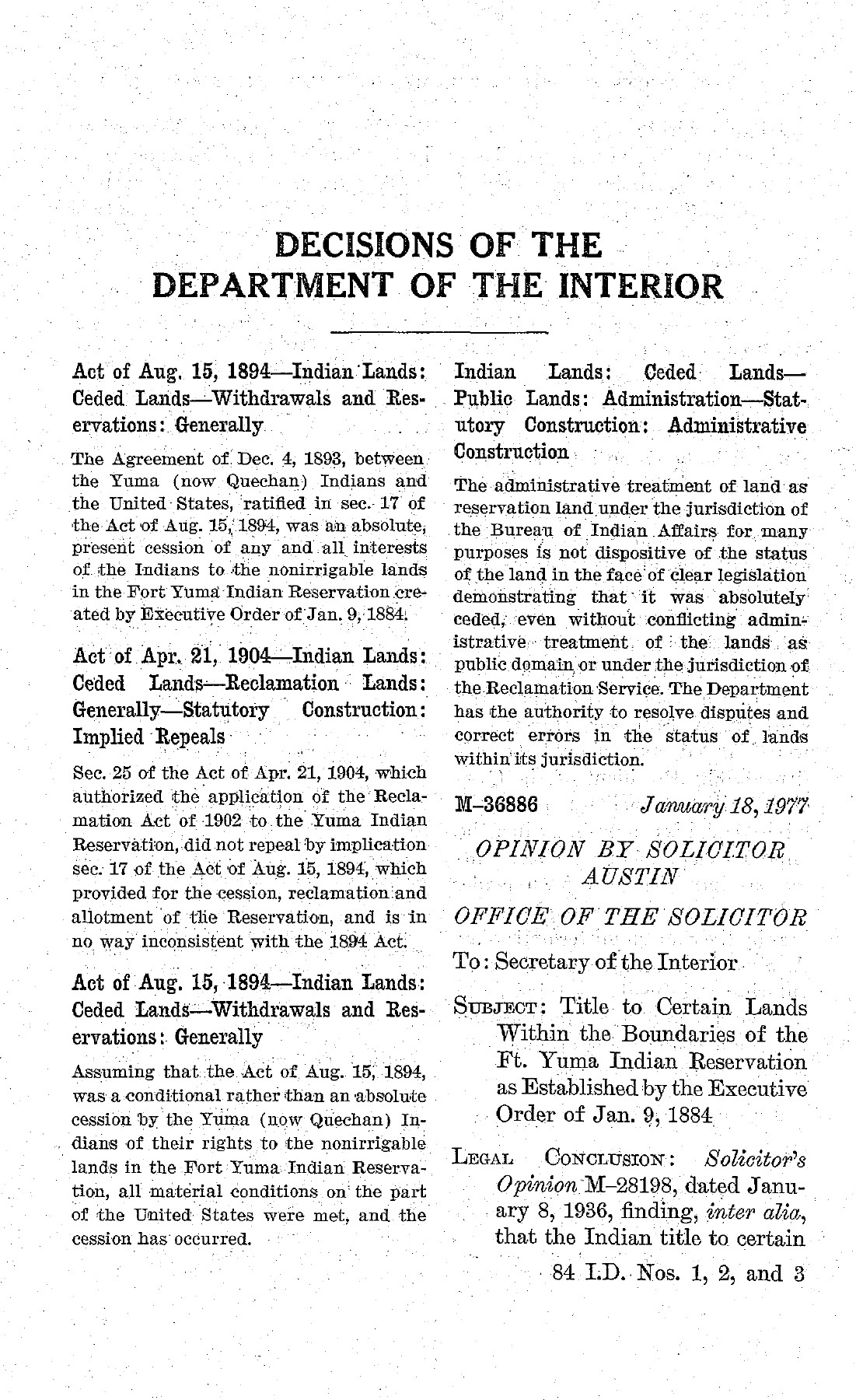
The 1977 Austin opinion occupies a crucial middle position in the Fort Yuma record. It came after the Tribe had pressed Interior to reconsider the 1936 Margold opinion, but before the Department changed its position in 1978. Across fifty-four published pages, it defended the conclusion that tribal title to approximately 25,000 acres of disputed non-irrigable land had been extinguished. The following year's reversal confronted this recent, detailed defense as well as the older opinion. [1] [2] [6]
The published document is M-36886, dated January 18, 1977. Its introduction explains that the Tribe had advanced a challenge to Margold's interpretation in 1973. After investigation, the Solicitor's office had decided to affirm the earlier conclusion, prompting inquiries and Senate oversight hearings. The formal opinion was presented as a response explaining the factual and legal justification for that position. [1]
That setting matters. The opinion was not a routine restatement issued in the absence of objection. It records a contested administrative reconsideration, with the Tribe challenging the federal account and officials defending their interpretation. Including the complete opinion makes the 1978 change intelligible as a reversal of articulated reasoning, rather than an unexplained administrative switch.
An express affirmation of Margold
Austin stated the legal conclusion at the beginning: Margold's 1936 finding that Indian title to certain reservation lands had been extinguished was well founded and affirmed. The opinion then reviewed the establishment of the reservation, the agreement, the ratifying legislation, subsequent statutes, administrative treatment, and arguments over the meaning of that sequence. [1]
Margold had reached his conclusion in response to questions concerning the All-American Canal and claims made by Indian Affairs on the Tribe's behalf. By 1977, the title dispute was being considered in a broader reconsideration of the reservation's history. The underlying question remained whether the non-irrigable acreage had passed from tribal ownership under the earlier arrangement. [2]
The distinction between an administrative opinion and a court judgment is important here. Austin supplied Interior's legal position. The document did not itself constitute a Supreme Court adjudication of every disputed boundary or water entitlement. Later departmental and judicial proceedings would consider related questions under their own authorities and procedural rules.
The argument for an immediate cession
Austin's central interpretation treated the 1893 agreement, as ratified in 1894, as an absolute present cession of the Indians' interests in the non-irrigable lands. That reading placed substantial weight on the surrender and relinquishment language and on the statute's treatment of the lands. It rejected the proposition that title necessarily remained with the Tribe because the proposed program contained further directions. [1] [3] [4]
This was the issue on which the text of Article I could not be separated from the rest of the agreement. The article tied surrender language to conditions stated later, while the later articles addressed allotments, sales, proceeds, and the treatment of different categories of land. Austin interpreted that overall arrangement as supporting extinguishment of title. Krulitz would later interpret it as a conditional conveyance that had not been completed. [6]
The two opinions assigned different legal consequences to the same agreement, its conditions, and the government's subsequent actions. Austin maintained that the disputed title had been extinguished; Krulitz later concluded that the conditions for conveyance had not been fulfilled. Their disagreement made the interpretation of the transaction itself central to Interior's reversal, rather than treating the later decision as a change unrelated to the original bargain.
The disputed category was non-irrigable land within the original reservation boundaries. The opinion did not assign one undifferentiated history to every individually allotted tract and every other interest in the reservation. The agreement and statutes distinguished land categories, proposed uses, and particular interests. Austin's conclusion had broad consequences for the disputed acreage, but it addressed an identifiable title question. Krulitz's later rejection of that conclusion returned to the conditions governing that same category of land. [1]
An alternative argument about performance
Austin also advanced an alternative position: even if the cession were treated as conditional rather than immediate and absolute, the material conditions on the United States' part had been met. This meant the opinion did not depend solely on rejecting the possibility of a conditional arrangement. It addressed that possibility and argued that it still led to the same result. [1]
That second route made the factual and statutory history of later irrigation and allotment especially important. If performance completed the conditions, officials needed to identify the actions that counted as performance and explain their relation to the earlier agreement. The 1904 reclamation provision became central because it authorized a later program affecting irrigable reservation land. [5]
The alternative argument also helps explain the scope of the 1978 response. Krulitz challenged not only the reading of the original cession language but also the claim that the later reclamation program fulfilled the original bargain. A full account of the reversal therefore needs both parts of Austin's reasoning. Reducing the 1977 opinion to a single sentence about title would conceal what the subsequent opinion actually had to answer. [6]
How the 1904 statute entered the analysis
Section 25 of the 1904 act placed irrigable lands on the Yuma and Colorado River reservations within a reclamation framework, provided five-acre allotments, and directed disposal of remaining irrigable land to settlers. It also established additional land charges and specified how receipts were to cover reclamation costs on allotted land before any remainder was credited for the Indians' benefit. [5]
Austin treated the 1904 law as consistent with the 1894 act rather than as an implied repeal. His opinion connected the later program to the earlier arrangement in defending the conclusion that the cession had taken effect. That interpretation gave subsequent agricultural development a role in answering the old land-title question. [1]
Krulitz later emphasized differences between the two programs, including the handling of proceeds, payment of reclamation charges, and the absence of the earlier interest provision in the later statute. The comparison identified a concrete interpretive dispute. Similar subject matter and the same five-acre allotment figure did not, in the later Solicitor's analysis, establish that the government had performed the financial and other obligations of the original arrangement. [6]
Administrative practice was disputed evidence
The record included instances in which federal officials treated the disputed land as reservation or tribal land. Austin's analysis did not regard that administrative treatment as controlling in the face of what he considered clear legislation effecting cession. He also recognized conflicting treatment and the Department's authority to resolve errors and disputes in the status of lands under its jurisdiction. [1]
This reasoning reflects a particular choice about evidentiary weight. If the legislation clearly transferred title, inconsistent later administration could be characterized as error rather than proof that the transfer never occurred. Krulitz's subsequent opinion gave the historical administrative practices a different role in interpreting the arrangement and assessing whether the cession's conditions had been met. [6]
The contrast is useful beyond the final conclusions. It shows that the disagreement involved how to read a historical record: what weight to give statutory words, surrounding circumstances, later implementation, and the government's own treatment of property. The same general categories of evidence could support different interpretations when the officials disagreed about the governing legal premise.
Existing third-party interests remained part of the landscape
Austin's historical discussion identified private rights and uses within the area, including interests predating the 1884 order. The opinion's account distinguished the Tribe's claim from challenges to certain preexisting rights. That context matters because a controversy over the broad status of non-irrigable lands did not necessarily mean every road, railroad, or other interest was asserted to be invalid. [1]
When Interior reversed course in 1978, protection of valid third-party interests remained explicit. The later recognition was not announced as extinguishing every intervening interest. Thus, although the opinions differed sharply on tribal title, the documentary sequence also contains careful attention to how that title related to other rights. [6] [7]
Those qualifications should not be used to dilute the significance of the reversal. They define its terms. Historical accuracy requires both the change in the Department's land-title interpretation and the protections or exceptions stated alongside it. A title conclusion and a schedule of other interests answer related but distinct questions.
The position Interior would reconsider
Austin's conclusion on printed page 54 maintained Interior's earlier position after a lengthy examination of the agreement, legislation, and administrative history. The length of the analysis reflects the competing routes by which the Department sought to justify its conclusion: an immediate cession, or performance sufficient to satisfy the arrangement's conditions. Krulitz's subsequent rejection of that position required addressing the relationship between those theories and the historical record. [1] [6]
The opinion is especially valuable when read between Margold and Krulitz. Margold shows the 1936 dispute and its initial resolution. Austin shows the Department defending that resolution after renewed challenge. Krulitz shows the Department rejecting the earlier reasoning and recognizing title held in trust, subject to specified interests. Together, they document an argument with a history, rather than a federal position that never changed. [2] [6]
The 1977 opinion records the position Interior held immediately before its reversal. It reveals the arguments the Tribe faced, the administrative response to reconsideration, and the precise positions reversed the next year. Leaving it out would make the eventual recognition easier to summarize but harder to understand.
Sources
1. M-36886, 84 I.D. 1–54 (January 18, 1977). M-36886, January 18, 1977; 84 I.D. 1–54. Download PDF · Source publication · Source PDF excerpt (54 pages).
2. M-28198 (January 8, 1936), Opinions of the Solicitor Relating to Indian Affairs, vol. 1, pp. 596–601. M-28198; pages 596–601. Read source PDF · Source publication
3. Agreement of December 4, 1893; S. Exec. Doc. No. 68, 53d Cong., 2d Sess., pp. 19–22 (1894). Articles I–VIII. Read source PDF · Source publication
4. Act of August 15, 1894, ch. 290, § 17, 28 Stat. 286, 332–336. Section 17; 28 Stat. 332–336. Read source PDF · Source publication
5. Act of April 21, 1904, ch. 1402, § 25, 33 Stat. 189, 224–225. Section 25; 33 Stat. 224–225. Read source PDF · Source publication
6. M-36908 (December 20, 1978), published at 86 I.D. 3–22 (1979). M-36908; 86 I.D. 3–22. Read source PDF · Source publication
7. Andrus Orders 25,000 Acres Restored to Quechan Indians’ Reservation (press release, December 21, 1978). Agency account of reconsideration and subsequent action. Read source PDF · Source publication