

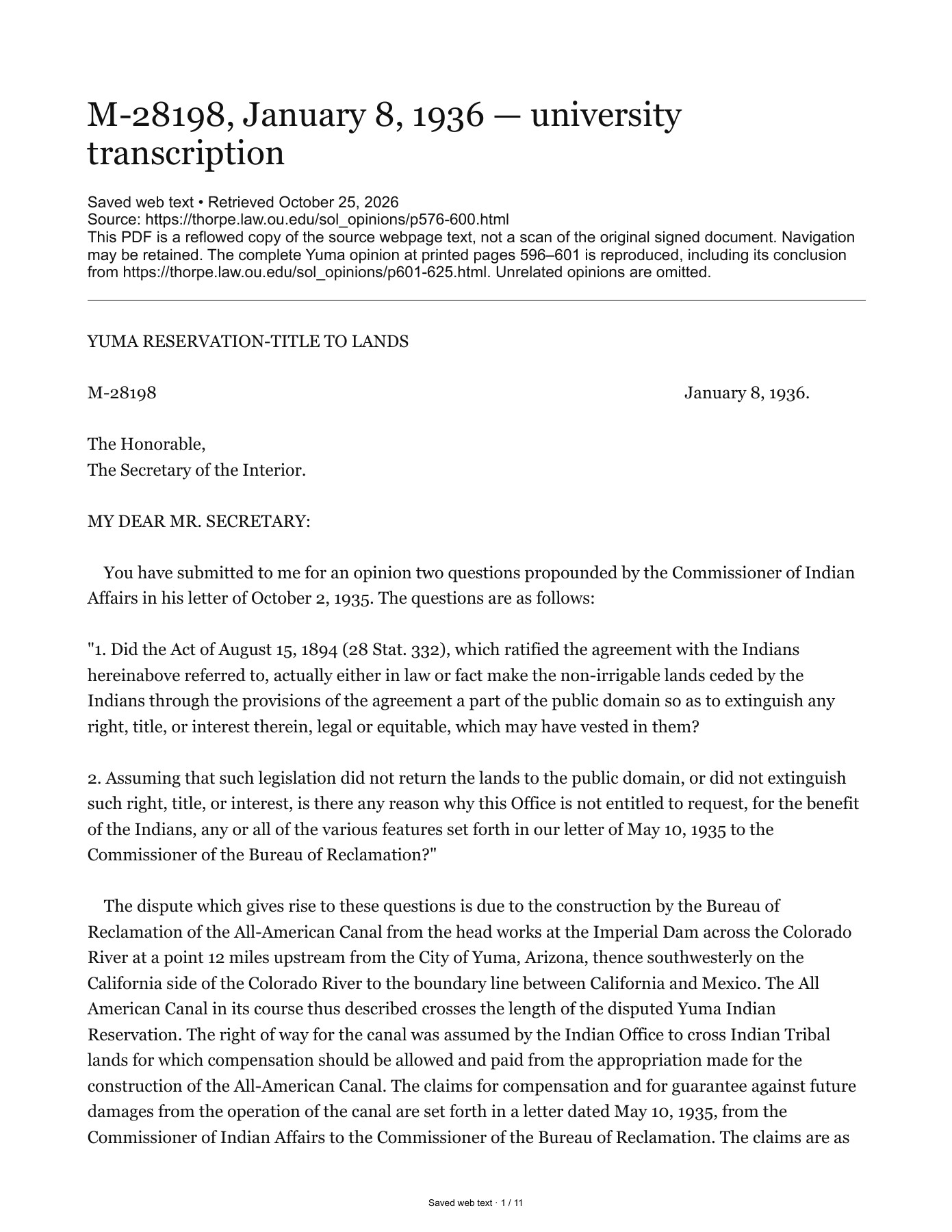
The land-title question answered by Interior Solicitor Nathan R. Margold in January 1936 arose from a practical conflict over the All-American Canal. The Office of Indian Affairs regarded the canal's route across disputed Fort Yuma lands as crossing tribal property and sought compensation and protections. The Bureau of Reclamation maintained that the non-irrigable land had become public domain under the 1894 legislation. Margold was asked to resolve the disagreement. [1]
His answer had consequences beyond a single right-of-way payment. He concluded that Indian title to the disputed non-irrigable lands had been extinguished through the agreement and ratifying act. On that basis, he rejected several demands that depended on tribal ownership. The opinion became a major statement of Interior's position until the Department later reversed its interpretation. [1] [6] [7]
The document should be read as a historical departmental legal opinion, with its questions, reasoning, and conclusions intact. It is neither the 1893 agreement itself nor a Supreme Court judgment. Its importance lies in the interpretation it supplied and the administrative consequences attached to that interpretation at the time.
The canal brought several claims into focus
The opinion reproduced a detailed list of requests made on behalf of the Indians. They included payment for land occupied by the right of way, protections against seepage and alkali damage, compensation for damage from canal failure, interests in minerals and construction materials, bridges preserving access, and payments associated with hydroelectric power sites. These were not merely abstract objections to a line crossing a map. [1]
The proposed right-of-way payment was based on an appraisal of $2,602.50, calculated at $1.50 an acre. Other requests addressed future risks and uses rather than a single upfront land value. Indian Affairs sought a substantial bond connected with drainage works and potential damage, and it identified access to hill and mesa lands as a reason for bridges across the canal.
The list explains why title mattered. If the disputed acreage was tribal land, ownership could support demands involving its occupation, materials, access, and use. Reclamation's response challenged that premise. By asserting that the land was non-irrigable public domain, it contested the foundation for several of the requested benefits. Margold's title analysis therefore governed more than the amount of one payment.
The proposed protections also reveal the difference between immediate occupation and future effects. Land could be occupied for the canal at construction, while seepage, drainage problems, or a break might affect neighboring property later. Power generation and extraction of materials introduced further kinds of value. Indian Affairs' list brought these distinct interests into one administrative dispute, and Margold's response separated them according to the legal basis he believed each required. [1]
The questions put to the Solicitor
The first question asked whether the 1894 act had made the ceded non-irrigable lands part of the public domain and extinguished any Indian legal or equitable interest. The second asked, if it had not, whether there was a reason Indian Affairs could not request the proposed protections and benefits. The opinion's organization followed that relationship between title and the resulting claims. [1]
Margold reviewed the 1883 and 1884 reservation orders, then the 1893 agreement and its ratification. He identified the California reservation created by the January 1884 order as the area at issue. That historical setup matters because the opinion was not about an undifferentiated collection of all lands ever associated with the Yuma people.
The agreement's opening language and later provisions supplied the central interpretive material. Margold treated the relinquishment as effective with respect to the non-irrigable category and rejected the argument that the land remained held for the Indians under the proposed arrangement. His analysis must be attributed to him because the Department's later opinion challenged both the interpretation and the significance assigned to subsequent performance. [2] [3] [6]
Cession, classification, and the timing of title
One part of Margold's reasoning addressed the fact that the irrigable or non-irrigable character of particular lands had not been determined at the agreement's date. He concluded that this did not postpone the legal operation of the relinquishment. His analogy was to land grants in which a later identification completed a title connected to an earlier statutory act. [1]
That reasoning linked classification to timing. In his account, once land was identified as non-irrigable, the relinquishment could take effect by reference to the earlier agreement rather than only at a later moment of classification. The distinction supported his rejection of the position that uncertainty about the category necessarily preserved tribal title in the interim.
He also relied on his understanding that the government had carried out the agreement's stipulations and that the Indians had received and accepted allotments and other promised benefits. That premise would become a point of disagreement in later reconsideration. The 1978 opinion disputed that the later reclamation program fulfilled the earlier conditional cession on its terms. [1] [4] [6]
The rejected ownership-dependent demands
At the conclusion of the opinion, Margold grouped several requests together because they depended on establishing Indian title to the non-irrigable lands. He said the claims for land value, mineral interests, sand and gravel, bridges, and power-site payments could not be sustained on that basis. This was the practical consequence of his title conclusion for the dispute presented to him. [1]
The grouping is useful because it shows how a legal characterization of the land affected several kinds of economic interest. Material taken for construction, access across the canal, and the value associated with power development were distinct subjects, but the opinion treated ownership as a common threshold for the claims as asserted.
The opinion does not establish that every imaginable claim relating to the canal was impossible under every later authority. It answers the submitted questions and the demands it reproduces. Extending its language into a timeless statement about all rights or all remedies would go beyond both its procedural setting and the subsequent history, including the Department's reversal.
Damage and a proposed bond received separate analysis
Margold separately discussed claims involving seepage, waterlogging, canal breaks, and related injury. These did not disappear merely because he rejected the asserted title basis for other requests. He analyzed potential responsibility for canal operations and the authority to require a bond, relying on the law and contractual arrangements as he understood them in 1936. [1]
His conclusion was that Interior could not compel the proposed bond absent statutory authority or a contractual obligation. He stated that the existing contract did not supply the needed requirement or reserved power. This portion of the opinion is historically important because it distinguishes an asserted right to preventive financial security from the possibility of a later claim arising from actionable damage.
Margold's treatment of canal damages shows the range of questions Interior faced in 1936. Land ownership, compensation for particular injuries, and security against future damage were related but distinct issues. His adverse conclusion on the Tribe's asserted ownership of the disputed lands did not eliminate the need to examine the proposed bond. The opinion addressed those demands separately, giving its canal analysis a scope beyond the central title question.
Reaffirmation and reversal
The land-title interpretation persisted long enough to become a central target of tribal efforts to obtain reconsideration. Solicitor Austin's 1977 opinion maintained the adverse conclusion. Solicitor Leo Krulitz's December 1978 opinion then overruled the earlier interpretations and concluded that the cession had been conditional and had not been completed. It recognized title held by the United States in trust for the Tribe, subject to the interests identified in that analysis. [5] [6]
Krulitz placed different weight on the agreement's conditions, the failure of the contemplated program, the distinct character of the 1904 statute, and administrative treatment of the land. The disagreement was therefore substantive. It was not simply a new label placed on a result that had always been the same.
The Supreme Court's 2000 opinion recounted the Margold position as part of the background to later claims litigation and additional water-rights claims. That later judicial account confirms the opinion's place in the historical chain while making clear that the legal controversy continued through other forums. A departmental interpretation from 1936 did not close the entire reservation history. [7]
The conclusion and its administrative afterlife
Margold's January 8, 1936 opinion, M-28198, appears at pages 596–601 of the first volume of Opinions of the Solicitor Relating to Indian Affairs. Its conclusion belongs to an earlier administrative position that Austin reaffirmed in 1977 and Krulitz rejected in 1978. The disagreement unfolded through a sequence of formal opinions, each addressing the effect of the agreement and legislation on the same disputed category of land. [1] [6]
The opinion ends by resolving the ownership-dependent demands and discussing the proposed bond, followed by Margold's name and the recorded approval. That sequence reflects the practical setting of the dispute: Interior needed answers about the Tribe's asserted land interest and about protections connected with canal construction. The disposition of the title question shaped some demands, while the bond raised its own questions about how anticipated damage would be addressed. [1]
Read in full, the opinion shows a major title interpretation emerging from concrete questions about a canal, its route, and its economic effects. The later reversal does not make the earlier document irrelevant. It makes the sequence indispensable. Margold's opinion explains the federal position that the Tribe challenged and supplies the reasoning later officials had to confront before recognizing a different account of the disputed lands.
Sources
1. M-28198 (January 8, 1936), Opinions of the Solicitor Relating to Indian Affairs, vol. 1, pp. 596–601. M-28198; Opinions of the Solicitor, volume 1, pages 596–601. Download PDF · Source publication · PDF copy of published webpage (11 pages).
2. Agreement of December 4, 1893; S. Exec. Doc. No. 68, 53d Cong., 2d Sess., pp. 19–22 (1894). Articles I–VIII. Read source PDF · Source publication
3. Act of August 15, 1894, ch. 290, § 17, 28 Stat. 286, 332–336. Section 17; 28 Stat. 332–336. Read source PDF · Source publication
4. Act of April 21, 1904, ch. 1402, § 25, 33 Stat. 189, 224–225. Section 25; 33 Stat. 224–225. Read source PDF · Source publication
5. M-36886, 84 I.D. 1–54 (January 18, 1977). M-36886; 84 I.D. 1–54. Read source PDF · Source publication
6. M-36908 (December 20, 1978), published at 86 I.D. 3–22 (1979). M-36908; 86 I.D. 3–22. Read source PDF · Source publication
7. Arizona v. California, 530 U.S. 392 (2000). Historical account of the Margold position and later proceedings; 530 U.S. 392. Read source PDF · Source publication