


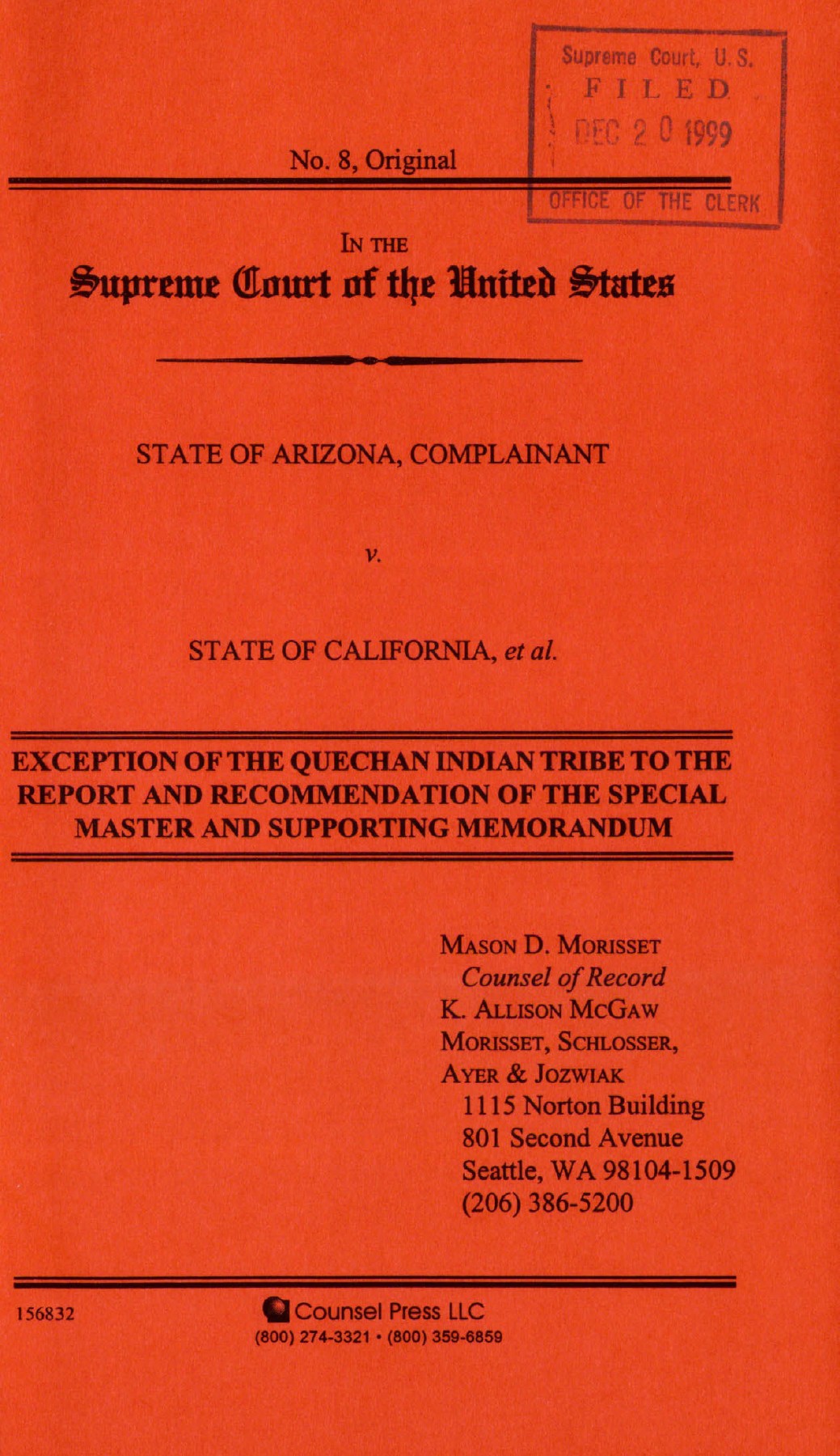
The Quechan Tribe's December 1999 filing asked the Supreme Court to remove a barrier to adjudicating additional Fort Yuma water rights. The Special Master had concluded that a settlement in an earlier claims case prevented the Tribe and the United States from proceeding with claims associated with disputed reservation lands. The Tribe's exception challenged that conclusion and argued that the earlier settlement had not resolved the boundary and water issues in the way the Master assumed. [1]
The filing matters as the Tribe's own legal account. The United States also sought further proceedings, but the federal brief should not stand in for the Tribe's memorandum. Each party explained its position through its own filing. Preserving the tribal brief gives readers direct access to the argument made on the Tribe's behalf rather than requiring them to reconstruct it from an opponent's description or a later summary. [3]
The Supreme Court subsequently allowed the claims to proceed, but that outcome did not convert every assertion in the Tribe's memorandum into a judicial finding. The filing made the Tribe's case against a threshold bar; the Court then supplied its own reasons for rejecting the asserted defenses. The settlement reached years afterward resolved the additional claims through another stage of negotiation and judicial approval. [2] [7] [8]
The question before the Court was a threshold question
The underlying controversy concerned lands within the original reservation framework and the additional reserved water claimed for them. The immediate procedural question was whether earlier litigation barred consideration of those claims. A ruling accepting the asserted bar would prevent a merits determination, regardless of how strongly the Tribe believed the historical land documents supported its position. [2]
The claims case identified as Docket No. 320 had a different origin and purpose. It involved claims against the United States arising from the reservation's land history. The later water proceeding involved a continuing interstate case in which the Tribe and the United States sought additional reserved water. Their connection was real, but their identity was contested.
That distinction makes the controversy intelligible outside legal terminology. The dispute was not simply whether the Tribe had once accepted money. It was whether the agreement and judgment resolving the earlier claims also settled or foreclosed the separate matters that had to be addressed to determine additional water rights. The Court had to examine the legal effect of the actual settlement. [2]
A claims case that changed while it was pending
The Supreme Court's later opinion recounts that the Tribe had advanced alternative theories in the earlier proceeding. One challenged the validity of the agreement; another sought compensation on the premise of an uncompensated taking. These alternatives arose against a federal position that the non-irrigable lands had been ceded. The existence of alternative pleading did not itself establish which historical theory was ultimately adjudicated. [2]
Interior's 1978 reversal changed the administrative setting. Krulitz concluded that the cession had been conditional and uncompleted, and the Department recognized the Tribe's entitlement subject to protected interests. The later published determination also preserved the possibility of appropriate compensation for past use. Recognition of continuing land rights and claims for historical compensation could therefore appear together in the record. [5] [6]
When the claims litigation settled in 1983 for $15 million, the parties did so against that changed background. The question in the water case was what the settlement actually resolved. The Court's 2000 analysis treated that context as significant rather than assuming that a monetary resolution necessarily meant the Tribe had sold or conclusively lost the lands in question. [2]
The Tribe challenged the meaning assigned to the settlement
The memorandum disputed the use of an unlitigated stipulation and consent judgment to block the later adjudication. It emphasized the parties' expectations, the absence of findings resolving the disputed boundary and water issues, and the risk of treating an assumed historical premise as though it had been established through litigation. Those were arguments for allowing the remaining issues to be heard, not requests to erase the earlier settlement. [1]
This distinction is central to the historical account. A party may accept that a settlement ends specified claims while disputing an opponent's proposed extension of its consequences. The later Supreme Court opinion addressed that problem by examining the difference between resolving claims and conclusively determining underlying issues for another case. [2]
The Tribe's challenge placed the consequences of the Master's interpretation directly before the Court. The party whose land and water claims were at stake disputed the meaning assigned to its earlier settlement. That disagreement was part of the threshold controversy: whether the old claims proceeding had resolved an issue decisively enough to prevent pursuit of the additional water claims.
The old title dispute remained in the background
The land history began with the executive-order reservation, the 1893 agreement, and the 1894 ratification. Interior's 1936 and 1977 opinions treated the disputed non-irrigable land as ceded. The 1978 opinion rejected that interpretation. The water litigation inherited this contested record rather than beginning with a single unchanging federal understanding of the land. [2] [5]
That background explains why the effect assigned to the 1983 settlement was so consequential. If the settlement were treated as conclusively establishing that the land had been taken, it could foreclose the later claims without resolving the competing historical interpretations on their merits. The Tribe's memorandum objected to the consequences of that approach. [1]
The Supreme Court's eventual disposition did not require a final determination of every land-history question at this threshold stage. It removed the asserted procedural barriers and returned the outstanding claims for further proceedings. The difference between a right to proceed and a final award is essential to describing the Tribe's success accurately. [2]
The federal and state filings frame the dispute
The United States' exception similarly challenged the Master's reliance on the Claims Court settlement. Its argument emphasized the shared understanding of the settling parties and requested a remand to determine the existence and quantity of additional reserved water rights. That alignment explains why the Court considered exceptions from both the United States and the Tribe. [3]
The state parties pressed a different exception. They challenged the Master's refusal to bar the claims under the earlier Arizona v. California proceedings and the finality principles applied to other omitted-land claims. Their position supplied a second potential barrier, distinct from the settlement issue the Tribe's memorandum principally addressed. [4]
Together, the filings show why a one-line summary of the case can be misleading. Several parties were disputing different parts of the same report, and success on one issue did not automatically resolve the other. The Court's opinion must be read for its treatment of both defenses and its directions for what happened next. [2]
The Tribe's independent participation also has a procedural history. The Court's account describes earlier efforts by the tribes to intervene and the later recognition of their participation in the case. By the 1999 exceptions stage, the Quechan Tribe was presenting its own memorandum and request for relief. That is different from appearing only as a beneficiary described in a federal filing. [2]
Preserving that distinction changes how the story is told. The record includes federal representation of reserved interests, tribal advocacy, state objections, a Special Master's recommendations, and the Court's decisions. The Tribe was an active litigant in the proceedings addressed here. Its memorandum allows readers to examine that participation directly, including the procedural consequences it challenged and the further adjudication it sought.
What the 2000 decision accomplished
Justice Ruth Bader Ginsburg's majority opinion rejected the asserted grounds for precluding the Fort Yuma claims and remanded the outstanding water-rights issues to the Special Master. The Court's settlement analysis did not treat the earlier consent judgment as a litigated determination that barred the separate claims. Its treatment of the earlier water-case defense also considered the state parties' failure to raise it at the appropriate stages. [2]
The decision thus preserved an opportunity with practical value: the Tribe and the United States could continue pursuing the additional entitlement rather than having the claims end at the threshold. But the opinion was not the final settlement decree and should not be described as an immediate award of all the water sought.
The subsequent history includes the Special Master's 2005 submission of final settlement materials and the Court's 2006 approval and consolidated decree. Those later documents record the negotiated resolution and its judicial implementation. They are the next chapters, not hidden provisions of the Tribe's 1999 memorandum. [7] [8]
The Tribe's participation in the proceedings
The memorandum records the Tribe's direct participation in a dispute often described under a case caption naming states. Its exception challenged the meaning assigned to an earlier settlement and the consequence that interpretation would have for the new water claims. That intervention placed the Tribe's account of its own claims history before the Court alongside the federal government's argument and the state parties' competing position. [1]
The brief's lasting value is that it preserves the Tribe's effort to prevent an earlier settlement from being read as the end of a different claim. It connects the reservation's contested land history to the procedural struggle over whether additional water rights could be adjudicated at all. Read with the opposing briefs and the Court's opinion, it restores the Tribe's argument to the center of an account too easily told only through federal decisions.
Sources
1. Arizona v. California, No. 8, Original, Exception of the Quechan Indian Tribe to the Report and Recommendation of the Special Master and Supporting Memorandum (December 20, 1999). Exception and supporting memorandum; sections 2–4 and appendices. Download PDF · Source publication · Source PDF (75 pages).
2. Arizona v. California, 530 U.S. 392 (2000). History of Docket No. 320, settlement analysis, and disposition; 530 U.S. 392. Read source PDF · Source publication
3. Arizona v. California, No. 8, Original, Exception of the United States and Brief in Support (December 1999). Federal exception and supporting brief. Read source PDF · Source publication
4. Arizona v. California, No. 8, Original, Exception by State Parties to Report of Special Master and Supporting Brief (December 20, 1999). State parties' exception and supporting brief. Read source PDF · Source publication
5. M-36908 (December 20, 1978), published at 86 I.D. 3–22 (1979). M-36908; 86 I.D. 3–22. Read source PDF · Source publication
6. 46 Fed. Reg. 11,372–11,376 (February 6, 1981); signed January 30, 1981. Trust recognition and compensation provisions; 46 Fed. Reg. 11,372–11,376. Read source PDF · Source publication
7. Arizona v. California, No. 8, Original, Special Master’s Approval of Final Settlements and Recommendations (June 14, 2005). Final settlement recommendations submitted June 14, 2005. Read source PDF · Source publication
8. Arizona v. California, 547 U.S. 150 (2006), decree entered March 27, 2006. Decree entered March 27, 2006. Read source PDF · Source publication