

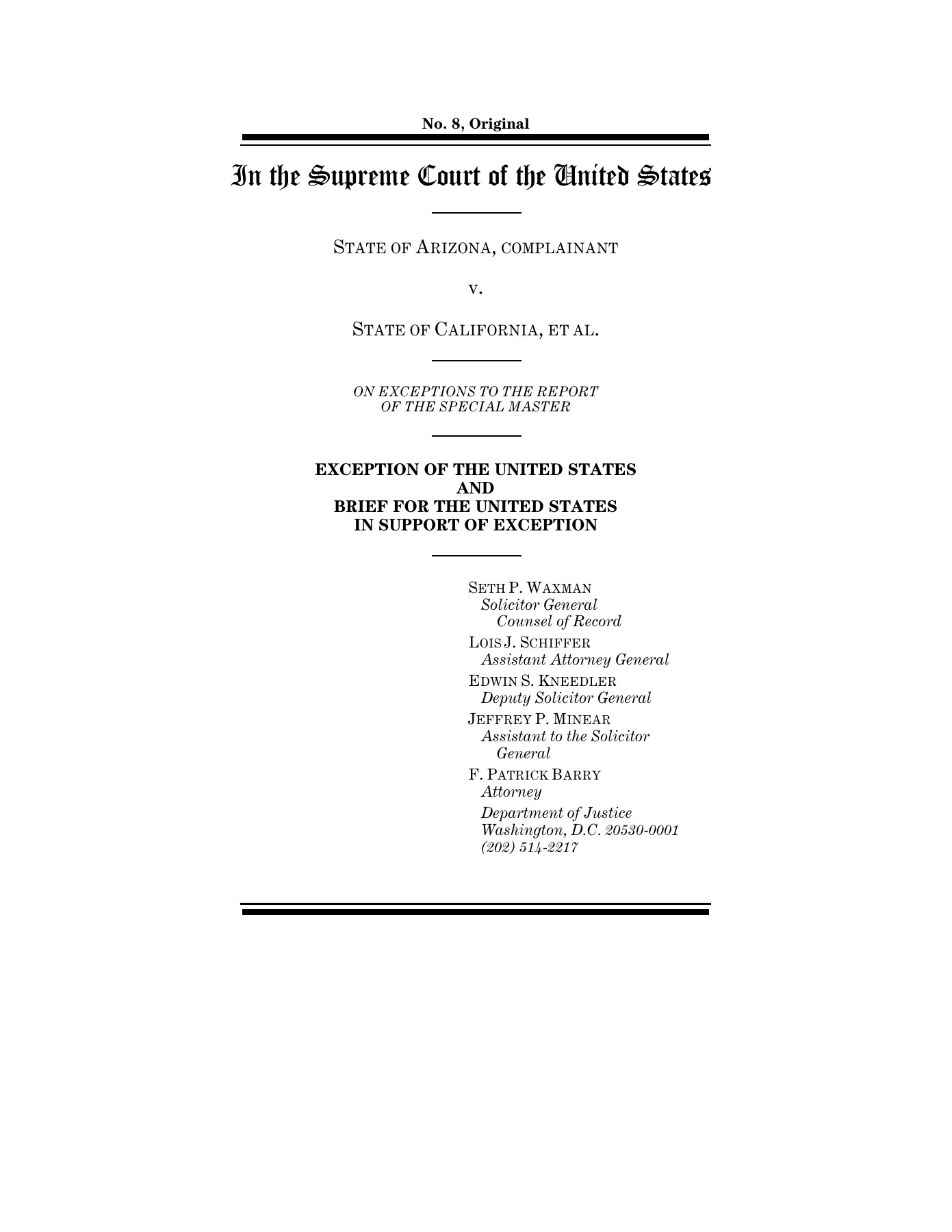
By December 1999, the Fort Yuma dispute before the Supreme Court had reached a threshold question: would the Tribe and the United States be allowed to pursue additional reserved water rights, or had an earlier settlement already closed that route? The United States' brief challenged the Special Master's recommendation that a 1983 Claims Court judgment barred the claims associated with roughly 25,000 acres of disputed boundary lands. [1]
The federal position was that the earlier case had settled claims against the United States without surrendering the reservation lands or deciding the additional water entitlement. The brief asked the Court to distinguish a settlement of historical claims from an adjudication of the separate water-rights question. It sought further proceedings before the Special Master, not an immediate final allocation of a specified amount of water. [1]
The filing is an advocacy document. Its historical account and legal characterizations express the United States' position. The Court's June 2000 opinion supplies the subsequent ruling and explains why the preclusion defenses did not bar the claims. Reading the brief beside that opinion makes it possible to distinguish what the government requested from what the Court actually decided. [2]
A state dispute with federal and tribal claims inside it
Arizona v. California began as an interstate controversy over Colorado River water. The United States intervened to assert water rights for federal establishments, including Indian reservations. Earlier decisions and decrees determined quantities and priorities while leaving certain reservation-boundary issues available for later resolution. The Fort Yuma claims reached the Court within that continuing litigation. [2]
This setting explains why an agreement from 1893 and a damages judgment from 1983 could become central in a water case. The additional claim depended on lands that the Tribe and the United States asserted belonged within the reservation. If an earlier judgment conclusively defeated that assertion or barred the water claim, the merits might never be reached.
The Special Master's report separated two asserted grounds for preclusion. One relied on the earlier Arizona v. California proceedings; the other relied on the Claims Court judgment settling the Tribe's case against the United States. The federal exception addressed the latter ground, which the Master had accepted. The state parties separately challenged the Master's rejection of the former. [1] [6]
Docket No. 320 had a different history
The Tribe's earlier claims case arose during the period when Interior maintained that the disputed lands had been ceded. As the Court later recounted, the Tribe pursued alternative theories: that the agreement was invalid and the government's use amounted to a wrong requiring compensation, or that the government had taken the land without compensation. Those were alternative legal routes in a claims proceeding, not a single uncontested historical finding. [2]
While that case remained pending, Interior changed its position. The 1978 opinion concluded that the cession was conditional and uncompleted, and the Secretary recognized the Tribe's entitlement to the disputed lands subject to the stated interests. That administrative change affected the context in which the claims litigation later settled. [3] [4]
The 1983 settlement provided a $15 million payment and resolved the claims in Docket No. 320. The central dispute in 1999 concerned what legal consequences followed from that resolution. Did payment necessarily establish a completed taking of the land, or could the parties settle the claims while proceeding on the understanding that the Tribe retained the land? The federal brief defended the latter account. [1] [2]
The government's account of the settlement
The brief organized its argument around the parties' understanding when they settled. It maintained that the United States and the Tribe understood the disputed lands to belong to the Tribe and that the settlement should not be transformed into an agreement relinquishing them. It drew on the sequence of administrative reconsideration and the earlier case's record to explain that position. [1]
That argument was consequential because the settlement did not contain a detailed judicial adjudication of every historical issue. A negotiated resolution can end claims without resolving all factual and legal disputes through trial. The federal lawyers argued that the Master had attributed an effect to the judgment that the parties had not intended.
The subsequent Supreme Court opinion examined that issue directly. It distinguished the effect of settlement on the claims actually resolved from the separate question whether contested matters were conclusively determined for another proceeding. Its treatment of the earlier judgment is the judicial answer; the brief records the government's reasoning for asking the Court to reach it. [2]
The Court ultimately did not need to adopt the government's invitation to examine presettlement materials as proof of that shared understanding. It found the judgment insufficient for issue preclusion because it did not select between the mutually exclusive theories presented in the claims case. That narrower route supported further proceedings without requiring acceptance of every factual characterization offered in the federal brief. [2]
This difference between argument and holding belongs in the account of a successful filing. The United States obtained the requested opportunity to proceed, but the Court supplied its own explanation for rejecting the asserted bar. The brief and opinion therefore remain complementary sources: one records the proposed reasoning, and the other identifies the reasoning that governed the judicial disposition.
Why the distinction between claims and issues mattered
In this litigation, preclusion concerned whether earlier proceedings prevented a later claim or foreclosed a particular issue. The terms can sound abstract, but the practical consequence was straightforward: if the Master's recommendation stood, the additional Fort Yuma water claims would be stopped before their substantive resolution. The federal brief argued that the earlier judgment did not justify that result. [1]
The Court later explained that settlements ordinarily resolve the claims they cover but do not automatically decide every underlying issue in the manner of a fully litigated judgment. The parties' agreement and intentions matter when determining whether a particular issue was meant to be conclusively settled. That analysis was applied to the record of Docket No. 320, rather than to a general assumption that payment necessarily purchased the disputed land. [2]
The difference is particularly important in a historical narrative. Saying that the Tribe received compensation does not, by itself, identify every legal interest surrendered or every future proceeding barred. Those consequences require examination of the settlement and the judgment. The federal filing sought precisely that examination instead of treating the dollar amount as the answer.
The appendices preserve the evidence behind the position
The brief's appendices include the agreement and records from the claims litigation. The federal argument relied on the documents surrounding the settlement to explain what the parties had resolved and what remained uncertain. Those materials connected the government's legal position to the earlier proceedings, including the competing bases on which the claims case had developed before settlement. [1]
The appendices also reconnect the 1999 dispute to the reservation's earlier history. The agreement's conditions, Interior's changing interpretations, and the claims case are not isolated episodes in the brief. They form the sequence used to explain what the parties believed remained in dispute and what they intended to resolve.
That documentary chain is one reason to retain a separate page for this filing even after the Court's opinion is available. The opinion states the judicial resolution. The brief shows how the federal government assembled its request for that resolution and what materials it placed before the Court. Each has a different evidentiary role.
The Tribe and the states filed their own accounts
The Tribe submitted its own exception and supporting memorandum. Although its requested outcome aligned with the United States on the settlement-preclusion question, its filing remains an independent expression of its litigation position. Including both avoids replacing the Tribe's argument with the federal government's representation of the dispute. [5]
The state parties' exception concerned the alternative defense based on the earlier water litigation. They urged finality and argued that the additional boundary-land claims should be treated consistently with prior rejection of omitted-land claims. Their filing demonstrates that the Court faced more than one route by which the water claims might have been barred. [6]
The three briefs should therefore be read as a set of competing and overlapping arguments. Their assertions do not become findings merely because they appear in an official court repository. The Court's later opinion identifies which arguments prevailed and the reasons for its disposition. [2]
A successful request for further proceedings
In June 2000, the Court rejected the asserted preclusion grounds and returned the outstanding Fort Yuma water claims to the Special Master. That result preserved the opportunity to pursue the additional entitlement. It did not finally quantify and award the disputed water in the same decision. [2]
The distinction defines the federal brief's place in the history. It helped present the case for keeping the claims alive when the Master's recommendation would have ended them. Negotiation and further proceedings followed, culminating in final settlement materials and the consolidated decree entered in March 2006. [7]
A prior damages settlement did not automatically become the last word on separate water claims. The United States challenged the proposed bar by examining the claims litigation and the settlement record. The Court's decision allowed the additional claims to proceed, creating the opportunity for the negotiations that followed. The brief belongs to that threshold dispute: it sought further adjudication rather than itself establishing the final quantity or terms of additional water.
Sources
1. Arizona v. California, No. 8, Original, Exception of the United States and Brief in Support (December 1999). Exception and supporting brief; argument, pages 14–43, and appendices. Download PDF · Source publication · Source PDF (116 pages).
2. Arizona v. California, 530 U.S. 392 (2000). Claims Court settlement and preclusion analysis; 530 U.S. 392. Read source PDF · Source publication
3. M-36908 (December 20, 1978), published at 86 I.D. 3–22 (1979). M-36908; 86 I.D. 3–22. Read source PDF · Source publication
4. 46 Fed. Reg. 11,372–11,376 (February 6, 1981); signed January 30, 1981. Recognition and provisions concerning compensation; 46 Fed. Reg. 11,372–11,376. Read source PDF · Source publication
5. Arizona v. California, No. 8, Original, Exception of the Quechan Indian Tribe to the Report and Recommendation of the Special Master and Supporting Memorandum (December 20, 1999). Tribe's exception and supporting memorandum. Read source PDF · Source publication
6. Arizona v. California, No. 8, Original, Exception by State Parties to Report of Special Master and Supporting Brief (December 20, 1999). State parties' exception and supporting brief. Read source PDF · Source publication
7. Arizona v. California, 547 U.S. 150 (2006), decree entered March 27, 2006. Approval of final settlement agreements and consolidated decree. Read source PDF · Source publication