


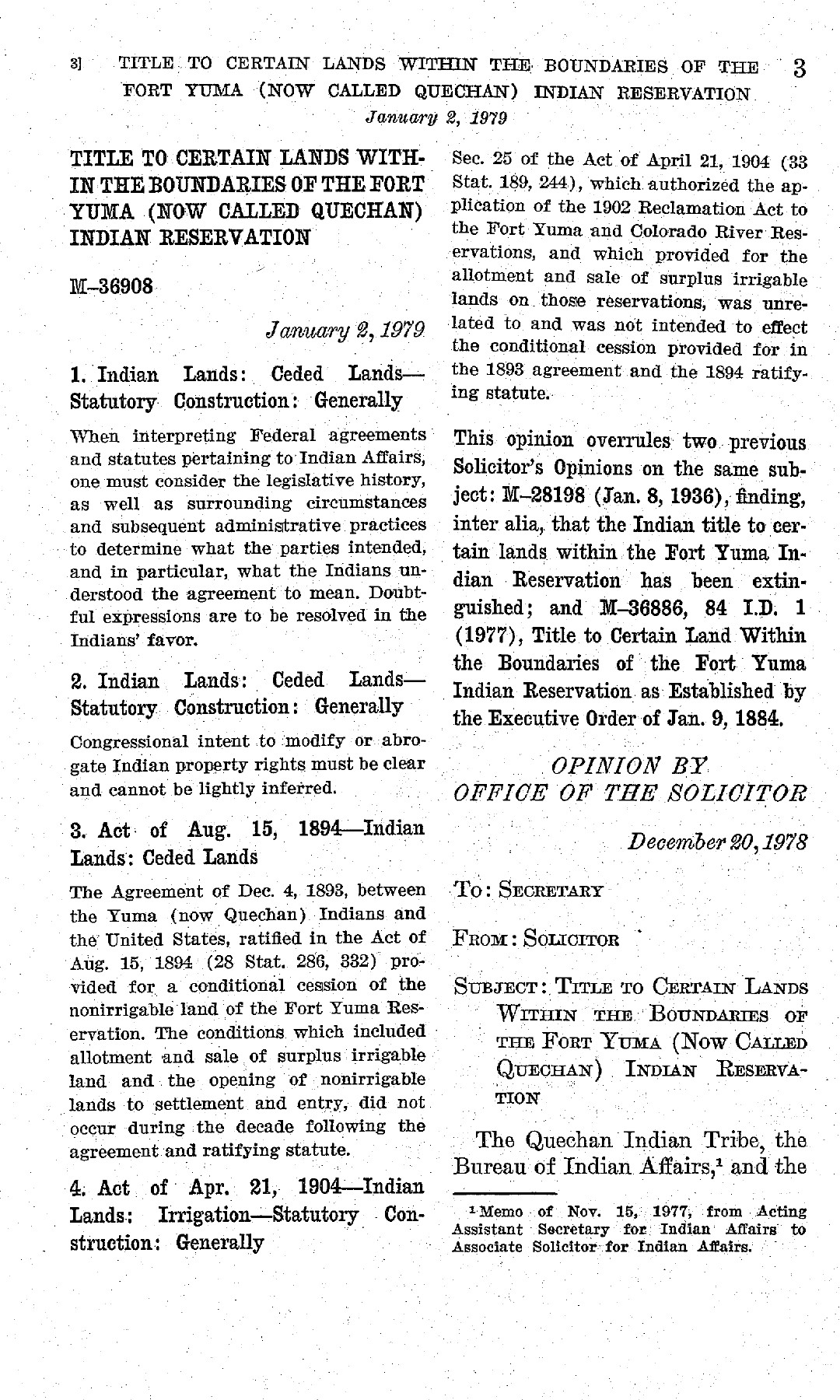
In December 1978, Interior Solicitor Leo M. Krulitz reversed the Department's earlier interpretation of the disputed Fort Yuma lands. His conclusion was that the 1893 agreement and 1894 statute provided for a conditional cession, that the conditions had not been fulfilled, and that the later 1904 reclamation law did not complete that cession. He recognized title to the subject property as held by the United States in trust for the Quechan Tribe, subject to identified third-party interests. [1]
The opinion directly confronted two predecessors: Nathan Margold's 1936 opinion and the 1977 Austin opinion reaffirming it. It also addressed the longer history of tribal requests for reconsideration, inconsistent departmental views, and the government's treatment of the land. Its significance lies in the legal explanation for the change, not simply in the fact that a new Solicitor reached a different result. [5] [6]
The source has two dates that should not be confused. The memorandum is dated December 20, 1978. The Interior Decisions reporter places it under a January 2, 1979 publication heading, at volume 86, pages 3–22. Those are different parts of the document's history, not evidence of two competing opinions. [1]
An exchange built around conditions
Krulitz treated the opening surrender language of the 1893 agreement as part of a larger arrangement. The agreement contemplated individual irrigable allotments, sale of surplus irrigable land under specified conditions, retention of proceeds for the Tribe, and opening of non-irrigable lands. Congress's ratification added implementation provisions involving irrigation and presidential action. [1] [2] [3]
In his analysis, the absence of a separate lump-sum payment or other independent compensation made the promised program especially important. The arrangement's benefits were found in the conditions and procedures themselves. Interpreting the agreement as an immediate transfer without regard to their fulfillment would detach the surrender language from the exchange it introduced.
That approach differed from Austin's argument for an absolute present cession. It also rejected the alternative claim that all material conditions had eventually been met. Krulitz therefore addressed both possible routes by which the earlier opinion had defended extinguishment of title: the meaning of the agreement at the outset and the legal significance of later events. [6]
The agreement's financial provisions give that reasoning a concrete setting. Sales were supposed to generate a fund, and the fund was intended to support water rents, agricultural works, equipment, and other stated benefits. The proposed transaction linked the disposition of one category of land to the usefulness of the allotments retained for members. In Krulitz's reading, that linkage prevented the surrender clause from being treated as the whole bargain. [2] [3]
This also explains why his discussion examined more than whether some irrigation eventually occurred. He asked which program produced the later benefits and whether its terms corresponded to the earlier arrangement. A later agricultural outcome could resemble the original objective while resting on a different financial and statutory structure. The opinion treated that difference as legally consequential. [1]
What did not happen under the earlier plan
The opinion's historical account emphasized that allotment and irrigation did not occur under the contemplated program during the decade following the agreement. It also noted the absence of the presidential proclamation that the ratifying statute contemplated for opening non-irrigable lands. These were not peripheral omissions in Krulitz's analysis; they concerned steps by which the arrangement was supposed to operate. [1]
The 1894 law had addressed a proposed canal and required construction to begin within three years or the previously granted right of way would be forfeited. It also tied a limited rent-free-water benefit to the start of actual delivery. Such provisions show why the conditions had practical content: land, water delivery, agricultural use, and financial benefits were interdependent. [3]
Krulitz's conclusion was that the original cession was not effectuated through that program. This was a departmental legal interpretation based on his reading of the documents and their history. It should be identified as such, while also recognizing its force as the opinion that overruled the Department's previous position.
The 1904 program was a different arrangement
The most substantial obstacle to the reversal was the argument that later reclamation and allotment supplied the promised performance. Congress had enacted section 25 in 1904, allowing irrigable reservation lands to be developed through the reclamation framework. Because that statute also referred to five-acre allotments, it could be read as related to the earlier plan. [4] [6]
Krulitz concluded that connection was insufficient. He compared the terms governing sales, proceeds, and reclamation charges. Under the 1904 statute, additional settler payments reflecting the value of unallotted land would first cover reclamation charges for the allotted lands, with a remainder credited for the Indians' benefit. The earlier agreement and statute contemplated different sale procedures and a fund bearing five percent interest. [1] [2] [3] [4]
The difference was not merely a new date on the same program. In Krulitz's account, the later statute served a broader reclamation undertaking and did not show the intention necessary to complete the earlier conditional cession of non-irrigable lands. He concluded that awareness of the old agreement in legislative history did not compel the inference that Congress had implemented it on its terms.
The land's administrative history mattered
Krulitz also examined the Department's own practices. He described treatment of the disputed non-irrigable acreage as tribal land before the 1936 opinion and cited actions consistent with that understanding. This evidence supported his interpretation that the earlier arrangement had not operated as the prior opinions assumed. [1]
Austin had taken a different approach to administrative treatment, arguing that it could not override clear legislation effecting cession. Krulitz placed it within the broader inquiry into the transaction's meaning and implementation. The disagreement was therefore methodological as well as substantive: it involved the relationship between statutory language, surrounding circumstances, and the government's conduct over time. [6]
The opinion's discussion of interpretive principles also emphasized attention to what the Indians understood and caution in inferring modification of Indian property rights. Those principles informed its reading of doubtful expressions and legislative intent. They were part of the reasoning supporting the reversal, rather than a substitute for examining the actual agreement and statutes.
Recognition came with protection of other interests
The opinion did not declare that every interest created during the decades of adverse federal interpretation vanished. Krulitz acknowledged valid third-party interests, including interests predating the reservation and others granted through congressional or departmental action. He also addressed lands taken for reclamation purposes. The concluding recognition of trust title was expressly qualified by the interests discussed in the opinion. [1]
This qualification matters because the word restoration can suggest a simple return to a map with all intervening history erased. The opinion instead dealt with a landscape containing rights of way, other interests, and federal projects. Recognition of tribal title and protection of qualifying interests were presented as parts of the same administrative resolution.
The subsequent agency announcement repeated that protection, and the 1981 published determination supplied a more detailed account and implementation directions. Those documents show how the legal conclusion was translated into administrative action. They should be read alongside the opinion, not treated as interchangeable versions of it. [7] [8]
The distinction between an opinion and implementation
Krulitz's opinion supplied the Solicitor's legal conclusion. The Secretary's action put the recognition into effect within Interior, and the Bureau of Indian Affairs announcement communicated the change publicly. The 1981 reissued determination later set out detailed directions concerning trust status, administration, and protected interests. The sequence separates the interpretation of the earlier land arrangement from the steps taken to implement that interpretation. [7] [8]
That distinction strengthens the account. It allows readers to identify which source supplies the reasoning, which reports the action, and which publishes the detailed determination and directives. Substituting a press release for a signed order would obscure those roles, even where the announcement accurately describes the Department's position.
The reversal also did not settle every later question about additional Colorado River water. Recognition of the land's trust status entered a wider litigation history involving reservation boundaries, earlier judgments, and the adjudication of water rights. The opinion was a decisive administrative event within that history, not the last document the history would require.
Why the reasoning remains the central evidence
The opinion's conclusion on printed page 22 expressly overruled the 1977 position and recognized trust title subject to vested interests. That result followed the comparison of the original agreement with the later reclamation program and the account of unfulfilled conditions. The conclusion was consequential because it changed Interior's answer to the ownership question while acknowledging that recognition had to coexist with qualifying interests already held by others. [1]
The most important change was conceptual and practical at once. Interior no longer treated the disputed non-irrigable land as having passed from the Tribe through a completed cession. It treated the old transaction as conditional and uncompleted, with the later reclamation program insufficient to supply the missing legal result. That is why the announcement described recognition of property that had never been ceded away, even while its headline used the language of restoration. [7]
For readers tracing the reservation's record, the opinion is the turning point that connects nineteenth-century promises to twentieth-century administrative recognition. Its explanation rests on specific documents, specific omissions, and specific differences between statutory programs. Those details give the reversal its historical substance and make the original opinion essential reading beside the shorter account of the Secretary's action.
Sources
1. M-36908 (December 20, 1978), published at 86 I.D. 3–22 (1979). M-36908, December 20, 1978; published at 86 I.D. 3–22. Download PDF · Source publication · Source PDF excerpt (20 pages).
2. Agreement of December 4, 1893; S. Exec. Doc. No. 68, 53d Cong., 2d Sess., pp. 19–22 (1894). Articles I–VIII. Read source PDF · Source publication
3. Act of August 15, 1894, ch. 290, § 17, 28 Stat. 286, 332–336. Section 17; 28 Stat. 332–336. Read source PDF · Source publication
4. Act of April 21, 1904, ch. 1402, § 25, 33 Stat. 189, 224–225. Section 25; 33 Stat. 224–225. Read source PDF · Source publication
5. M-28198 (January 8, 1936), Opinions of the Solicitor Relating to Indian Affairs, vol. 1, pp. 596–601. M-28198; pages 596–601. Read source PDF · Source publication
6. M-36886, 84 I.D. 1–54 (January 18, 1977). M-36886; 84 I.D. 1–54. Read source PDF · Source publication
7. Andrus Orders 25,000 Acres Restored to Quechan Indians’ Reservation (press release, December 21, 1978). December 1978 agency announcement. Read source PDF · Source publication
8. 46 Fed. Reg. 11,372–11,376 (February 6, 1981); signed January 30, 1981. Complete reissued determination and directives; pages 11,372–11,376. Read source PDF · Source publication